
What Anna Julia Cooper Can Teach Us About Universalism
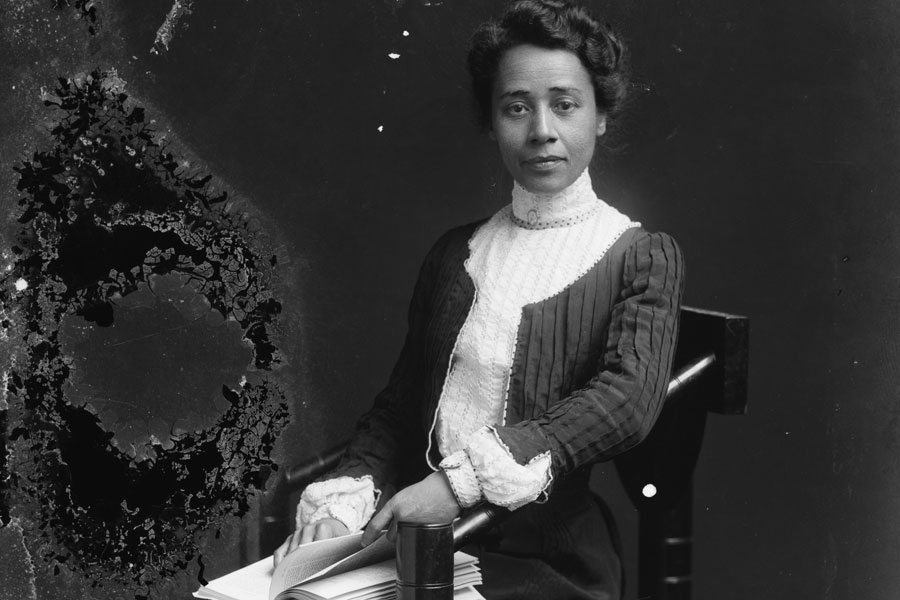
In today’s post, Mickell Carter, an editorial assistant at Global Black Thought (the official journal of AAIHS), interviews Keidrick Roy about his article, “‘The Wrong End of the Telescope’: Anna Julia Cooper’s Concrete Universalism,” which conceptualizes “concrete universalism” and “individual self-determination” in Anna Julia Cooper’s writings. The theory of concrete universalism recognizes that an individual’s experience as part of a subjugated group can cultivate greater sensitivity to the ethical development of universal values usually associated with the rationalistic abstractions of Enlightenment liberal ideas. Within a concrete universal framework, particular experiences neither overdetermine universal principles nor are they rendered irrelevant to expressing fundamental truths about human nature. In this way, concrete universalism resists unproductive forms of skepticism and relativism on the one hand and “colorblind” abstractions on the other.
Keidrick Roy is an assistant professor of Government at Dartmouth College and author of American Dark Age: Racial Feudalism and the Rise of Black Liberalism, a study of how medieval legacies haunt U.S. liberal democracy. American Dark Age received the Best Book in American Political Thought Award (American Political Science Association) and the Best Book in Intellectual History Prize (Society for U.S. Intellectual History), among others. Keidrick teaches courses on the history of American political thought and researches the evolution of core concepts such as liberalism, nationalism, and conservatism in the United States from the Revolutionary era to the present. His interdisciplinary work foregrounds African American intellectual traditions in rethinking current debates over patriotism, religion, and civic optimism.
Mickell Carter (MC): Your article focuses on the thought of Anna Julia Cooper and introduces the concepts of “concrete universalism” and “individual self-determination” to explain different aspects of her philosophy. Could you discuss what inspired you to pursue this research and how you are defining these terms?
Keidrick Roy (KR): Although I was an English major in college, I took nearly all of my elective courses in the Philosophy department (the Air Force Academy did not have a philosophy major when I graduated in 2009). I loved my classes in American philosophy, metaphysics, epistemology, and logic. Working at that level of abstraction was exhilarating—it helped me spot the assumptions and presuppositions that held together worldview-shaping claims. When I returned to academia as a grad student after eight years in the military, I kept an interest in broad literary and philosophical questions but began focusing on more concrete areas such as political philosophy. I also started devouring history books that tested and refined some of my philosophical assumptions. My first year of graduate school was shaped by an extraordinary group of historians—Evelyn Brooks Higginbotham, Vince Brown, Walter Johnson, and my advisor, John Stauffer. Through them, I became interested in the relationship between history and philosophy, and in how ideas changed over time or held their shape across contexts.
That’s when I started systematically reading Enlightenment-era philosophy. I found it provided incisive frameworks for engaging with intellectual historical questions. However, I noticed that African American thinkers were rarely, if ever, mentioned in the primary and secondary literature of the Enlightenment, even though African Americans had been writing and responding to Enlightenment thinkers since the eighteenth century, from Phillis Wheatley Peters and Lemuel Haynes in the Revolutionary period to the present. My dissertation project thus aimed to reconstruct the Enlightenment tradition—particularly ideas of reason, science, liberalism, and progress—from the perspective of African American thinkers. I wrote the dissertation as two volumes: the first came out two years ago as American Dark Age: Racial Feudalism and the Rise of Black Liberalism, and the second forms the core of my forthcoming book on the African American Enlightenment tradition. It’s called The Underground Enlightenment (Princeton UP).
And here’s where Anna Julia Cooper comes in. The chronology of American Dark Age ended around 1865, with Black Americans wrestling with the legacy of Enlightenment liberal ideas that presupposed some kind of moral, intellectual, or physical darkness, a darkness they described by reference to notions of “feudalism” or “the Dark Ages.” A colleague who read a draft of that book, Kristin Waters, pointed me to Anna Julia Cooper’s A Voice from the South (1892), where Cooper references the term feudalism. I became captivated by Cooper’s writing in that idiom and her wrestling with terms such as “enlightenment” and “liberal.”
I then started reading all of Cooper’s published writings, beginning with Shirley Moody-Turner’s outstanding volume The Portable Anna Julia Cooper. Soon, I discovered that Cooper was more than an interlocutor for my work on feudalism: she was—in many ways—the apotheosis of the African American Enlightenment tradition I had been thinking about for almost a decade. Importantly, Cooper held in tension the abstractions of philosophy’s universal ideas and the concrete experiences African Americans faced throughout history. She moved between these registers fluidly, all the while centering the gendered dimensions that were attenuated in the writings of most of her better-known male forebears.
My Global Black Thought essay introduces two concepts that, in my view, animate many of Cooper’s insights that bridge philosophy and history: “concrete universalism” and “individual self-determination.” Concrete universalism affirms the legitimacy and priority of universal values (against, for example, moral relativism) and maintains that an individual’s experience as part of a subjugated group can cultivate greater sensitivity for the proper refinement and articulation of those values. It also encourages interrogating social structures purportedly rooted in universal ideas that are actually bound up in particularist exclusionary mechanisms. In 1893, Cooper made a speech at the Chicago World’s Fair advocating for women’s rights that captures the flavor of the concept with the unforgettable line: “Let woman’s claim be as broad in the concrete as in the abstract.”
Individual self-determination is the attitude that enables concrete universalism. It captures a slice of African American life I had been steeped in while growing up in Black churches in Texas and spending my summers with relatives in Mississippi. It was a can-do attitude that openly acknowledged systemic injustices without dwelling on them. It defied defeat. It was an irrepressible will to rise above one’s circumstances that I admired in my elders. At times, I can hear some faint reverse echoes of my mother (a K-12 teacher) and father (an enlisted soldier) in Cooper’s work when she writes: “One may make the mistake of looking at race handicaps through the wrong end of the telescope and imagining that oppression goes only with color. When I encounter brutality, I need not always charge it to my race. It may be—and generally is—chargeable to the imperfections in the civilization environing me for which, as a teacher and trained thinker, I take my share of responsibility.” As children in the South born before the Civil Rights Act and Voting Rights Act, they taught me to work on and through myself in concert with God to change my circumstances. That’s Cooper’s individual self-determination.
MC: How do you understand the tension in Cooper’s thought between individual self-determination and the need to confront systemic forms of racial and gender oppression?
KR: Cooper is a complicated figure who has been credibly critiqued for leaning too far into the language of respectability and uplift. Kevin Gaines put it this way: “Much of what contemporary readers recognize as ‘feminist’ in Cooper’s writing cannot easily be disentangled from her Western ethnocentrism, her staunch religious piety, and a late Victorian bourgeois sensibility distrustful of social democracy.” This is an important critique that anyone approaching Cooper’s corpus of work must reckon with.
I read Cooper as ultimately recognizing the interlocking structures of racial and gender oppression while neither denying the force of their constraints nor displacing blame for inequality onto Black people. Instead, she holds that overcoming malign structural or systemic forces means rejecting false notions about the intellectual and creative capacities of Black people and women embedded in their premises.
She firmly believes in the individual’s capacity to effect change—even against the formidable treacheries of a hostile system. At the same time, she affirms collective forms of agency forged through churches, schools, and other community associations. Importantly, Cooper resists individuals purporting to represent a group and groups overriding individual expressions of self-determination (for her, figures such as Martin Delany serve as paradigmatic examples of this double infraction). All told, she acknowledges the necessity for social change and its associated challenges while affirming the individual and collective abilities of African Americans.
MC: You show how Anna Julia Cooper’s analysis of feudalism, particularly what you call “racial feudalism,” shaped her critique of racial and gender hierarchies. Could you explain this further and expound on her understanding?
KR: In American Dark Age, I describe racial feudalism as a network of terms and an ideology that analogizes fanciful impressions of ascriptive medieval hierarchies to modern race-based social stratifications in an American republic claiming to have superseded the “dark ages.” Across early and antebellum U.S. History, both white and Black Americans, from Thomas Jefferson and John Adams to Frances Ellen Watkins Harper and Frederick Douglass, juxtaposed life in the United States with the conditions of the medieval world, though often toward different ends. As I mentioned earlier, my initial interest in Cooper stemmed from the ways her writings employed notions of feudalism in the late nineteenth century, which fell outside the chronological scope of my first book. Her masterwork, A Voice from the South (1892), gave me an opportunity to show how Cooper productively compared the Middle Ages and Victorian notions of womanhood while diagnosing the particular oppressive structures Black women encountered in her own era. Specifically, she held that contemporary views of women emerged from “Christianity and the Feudal System” and contended that while feudalism “magnified and elevated woman’s position in society” by way of the chivalric ideal, the only women who were duly respected were the “elect few” among whom men “expect to consort.” More broadly for her, while Americanized feudal ideas trumpeted the idea of women, those same ideas routinely undermined women’s political power and social standing, often excluding Black women from its illusory benefits altogether. The recrudescence of feudalism, then, undermined the universalist ethos Cooper deeply held and championed.
MC: How does your reading of Cooper complicate or expand our understanding of her within Black political thought?
I read Cooper’s oeuvre as producing creative friction with some contemporary currents in Black Studies. The Afropessimist affirmation of social death’s permanence and of an intractable antagonism between Blackness and the category of Human, as in Frank Wilderson and Jared Sexton, sits opposed to Cooper’s commitment to the possibility of universalism and progress. On a different front, Charles Mills aims to remake liberalism by exposing the racial contract underwriting its idealized theory. By contrast, Cooper reconstructs a workable liberal framework from below, through individual self-determination. More broadly, Cooper’s writing, which presupposes the efficacy of agency and the availability of universal ideas, advances a reformulated (small-e) enlightened liberal vision that preserves the normative force of universality without reproducing its abstract exclusions. I hope my piece will help us place Cooper and her interlocutors within ongoing cross-century and cross-disciplinary conversations about the utility of these concepts.
In the end, Cooper’s sense of concrete universalism discourages what she calls the “pessimists” of her own era while inspiring a multiplicity of Black voices to speak for themselves rather than a single figure speaking for the whole, as with Martin Delany and Booker T. Washington, both of whom she criticizes by name.
Instead, Cooper argues for reversing the telescope to approach a universal vision of society inductively from the bottom up. As she puts it: “The extent, then, of the optimism in my philosophy is that . . . the solutions of our problem will be individual and not en masse; and the habit of generalization and deductive logic has done its worst.” Though it may seem paradoxical, Cooper gives us the intellectual tools to particularize universal concepts enough to ultimately expand their reach. Her ideas can help us look at life through the proper end of the telescope.
Copyright © AAIHS. May not be reprinted without permission.