
Mary Church Terrell, Reproductive Loss, and the Meaning of Motherhood
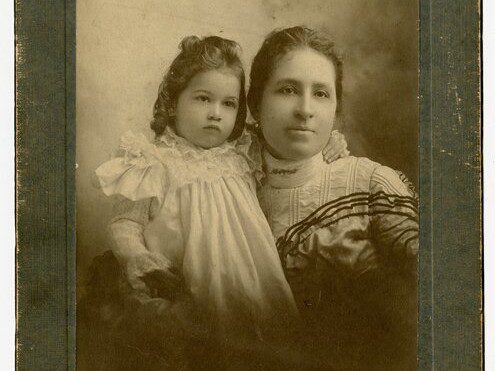
Mary Church Terrell provides us with a unique glimpse into the struggles of infertility for a Black woman at the turn of the twentieth century. Though infertility is a modern term, the effects of the challenges surrounding conception, pregnancy, and childbirth have been felt by women throughout history. As historian Shannon Withycombe argues in Lost: Miscarriage in Nineteenth Century America, infant loss and miscarriage were common for women throughout the nineteenth century and should be included in the reproduction and fertility historiography. Black Press publications, personal correspondence, and autobiographical recollections reveal Mary Church Terrell’s deeply personal journey of infertility, loss, and, ultimately, motherhood.
Mary Church married Robert Terrell in her family’s Memphis home on October 28, 1891. Mary quickly became pregnant, but unfortunately, she miscarried eight months into her marriage. It’s not clear how far along she was in the pregnancy.
Her second miscarriage occurred in late 1895, and while it is unclear how many weeks into gestation she was, the archival record shows her women’s club community and friends knew of the pregnancy and the sex of the baby: a little boy. Given her prominence in the club community, it makes sense that her loss is mentioned in The Woman’s Era–Black women’s journal that ran from March 1894 until January 1897–in order to allow fellow members to provide condolences to her and her husband.
Terrell became pregnant for a third time in 1896. She spent that summer deep in deliberations, serving as a key broker between the National Federation of Afro-American Women and the National League of Colored Women over the formation of a new national Black women’s club organization. Terrell, with her organizational prowess and steady leadership, helped bring to fruition an umbrella organization for Black women’s clubs: the National Association of Colored Women (NACW). However, this pregnancy ended in stillbirth. Given her rise in national prominence, Black Press outlets reported on both her activism and personal life. The Woman’s Era reported: “All members of the National Association, as well as many others, will be interested to know that a daughter was born to the President, Mrs. Mary Church Terrell. We are sorry that we are obliged to add that the little stranger only lived a couple of days. Mr. and Mrs. Terrell have the sympathy of hosts of friends.”
While suffering through miscarriage and infant loss, Terrell became the NACW’s first president. But even with all her accomplishments, she still recalled the pain and longing to give birth to a healthy baby in her autobiography:
When my third baby died two days after birth, I literally sank down into the very depths of despair. For months I could not divert my thoughts from the tragedy, however hard I tried . . . A few of my friends could not understand how a woman could grieve so deeply as I did over the death of a baby that had lived only a few days. But I sometimes think a woman suffers as much when she loses a baby at birth as does a mother who loses a baby who has been with her much longer. There is a bitter disappointment of never having enjoyed the infant at all, to who’s coming the mother has looked forward so long and upon whom she has built such fond hopes.”
Terrell acknowledged the benefit of keeping busy during this emotionally challenging time. She reminisced, “The meeting was held in July and at the time I was expecting a little stranger who would arrive, I hoped, the last of September . . . It was a bitter, grievous disappointment to Mr. Terrell and myself, but like other mothers who have passed through this Gethsemane, I pulled myself together as best I could and went on with my work . . . obliged to be interested in the troubles and trials of others, I had little time to think of my own aching heart.” Throwing her energy into her NACW presidential duties provided relief and purpose during this period of grief.
After three infant losses in five years, Terrell and her husband went looking for possible answers. Her husband wrote to Mary’s father, stating, “Mollie is in New York with her mother. Her condition is not at all encouraging and she is having consultations with leading physicians in New York. I am afraid that she is losing ground.” According to these letters, doctors believed she had some form of endometriosis or a pelvic cyst. Like so many other women dealing with similar health issues, the root cause of her infertility and infant loss was unclear. She underwent experimental surgery and electrotherapeutics in the hope of conceiving and carrying a healthy baby to term. Robert Terrell wrote, “From Mollie’s perspective, this operation was her last chance to have a healthy, living child.”
This must have been such a hard period in Mary Church Terrell’s life. She underwent months of testing, needles, and invasive examinations, hoping and praying for a living child. She wrote, “I felt I would rather die trying to regain my health than drag out a weary, useless existence as an invalid.” How jarring it is to hear these words. Despite all her accomplishments, she felt incomplete without a child of her own.
Terrell did ultimately give birth to a healthy baby girl. Her daughter Phyllis was born in 1898 during her second term as president of the National Association of Colored Women. We don’t know if the experimental treatments she received in New York aided in the successful completion of her pregnancy or if it was another factor, but she embraced motherhood as part of activist work. In addition to Phyllis, she adopted her niece, also named Mary, and accepted her into her family as if she was her biological daughter.
Letters and speeches demonstrate how her hopeful transition to motherhood, eventual mothering, and activism work became enmeshed, both deserving of Terrell’s time and attention. As president of the NACW, she platformed children’s and youth initiatives, including kindergartens, educational opportunities, and employment training opportunities. During her First Presidential Address to the National Association of Colored Women, held Sept. 15, 1897, she stated, “To the children of the race we owe, as women, a debt which can never be paid, until herculean efforts are made to rescue them from evil and shame, for which they are in no way responsible. Listen to the cry of the children, my sisters. Upon you they depend for the light of knowledge, and the blessing of a good example. As an organization of women, surely nothing can be nearer our hearts than the children.” Though at the time of her speech in 1897 she was not a mother herself, Terrell recognized the importance of investing in future generations.
She did not stop her activist work as a mother–she instead brought Phyllis and Mary along when travelling for speaking engagements. In a June 25, 1902, letter to her husband Robert, she recounts a fun day with Phyllis in Cambridge, Massachusetts: “After the dinner we went out to Norumbega Park, a fifty-minute ride, past Newton, Auburdale, Brookline. After we reached the park, he took P to see the animals, took her on the Merry Go Round, which transported little daughter to the seventh heaven. She certainly enjoyed the trip.” The opportunity to joyfully embrace motherhood after years of infertility and heartbreak must have been so healing.
Through hardship and joy, Mary Church Terrell’s infertility journey shaped her activism and motherhood. Even through the joy of motherhood, we see how the heartache associated with her reoccurring infant loss and miscarriage left emotional scars. However, this pain did not hinder her activism, and she centered the challenges facing Black youth and children. She consistently focused on the needs of future generations, choosing to invest in their collective future, regardless of her status as a mother.
Copyright © AAIHS. May not be reprinted without permission.