
Exceeding the Bounds of the Black International
This post is part of our online roundtable on Christopher Tounsel’s Bounds of Blackness.
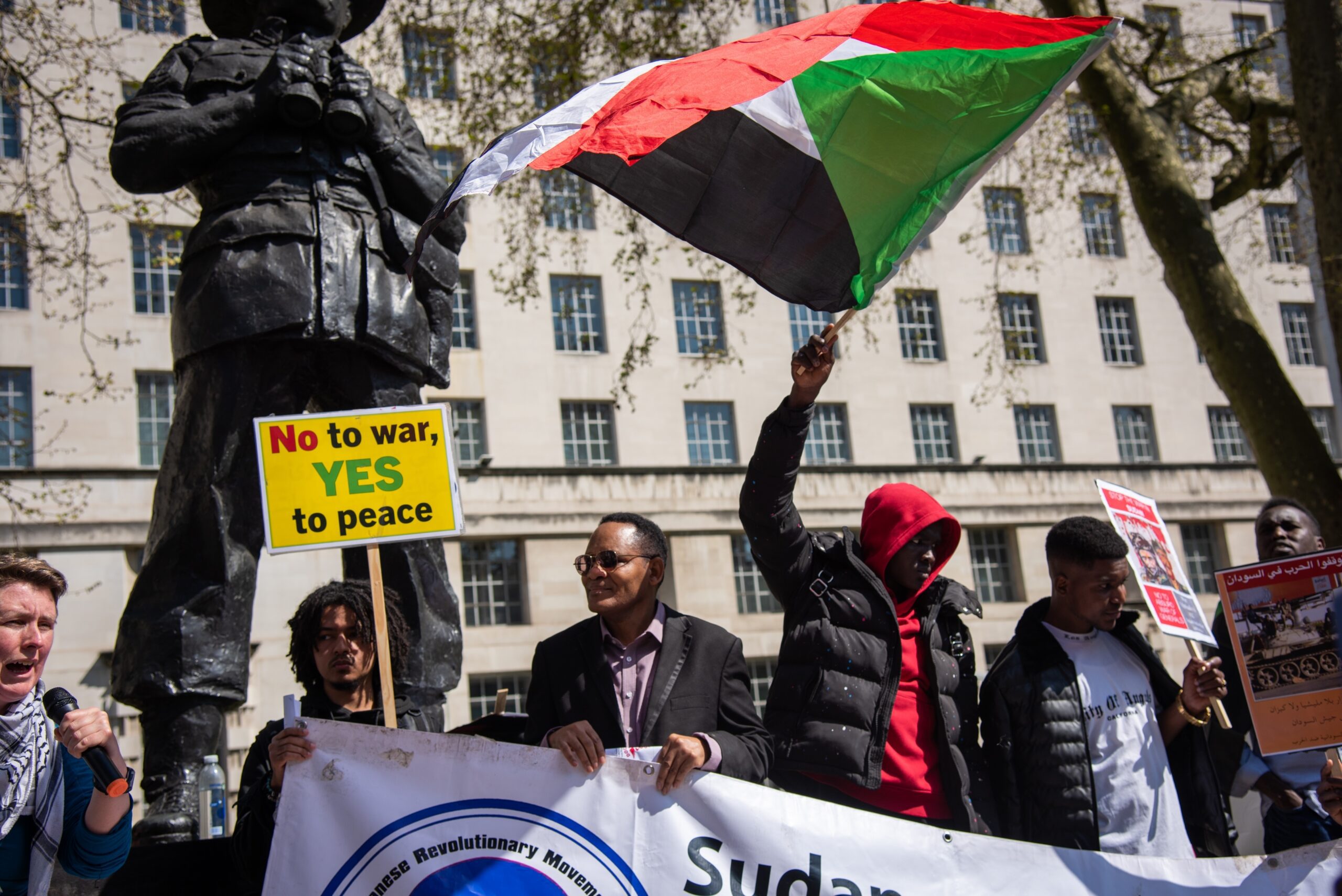
Recent scholarship has probed a Black International that exceeds the limits imposed by a narrow focus on Atlantic routes of slavery and colonialism. Bounds of Blackness: African Americans, Sudan, and the Politics of Solidarity shares this broader vision of the Black International and challenges the assumption that peoples of African origin experienced slavery, racism, and colonialism in identical ways.1 Some studies of former colonies have returned to the precolonial era to recover the roots of these nations’ contemporary conditions. They thus challenge the presumption that colonial experiences have been determinative of present conflicts. The impact of changing perspectives on Black globality has also been most marked in approaches to diaspora that locate difference rather than similarity in diverse peoples’ experiences of migration and dispersion.2 In these works, there exists a certain displacement of African Americans from their previous roles in many accounts as the most central actors in global Black history. Instead, this group is increasingly viewed in tandem with the political and cultural objectives of other Black nationalities and ethnicities as well as some that are not of Black descent. Christopher Tounsel has captured these dispositions and applied them to a nation that is one of the largest on the African continent, but one of the least examined from the standpoint of African American interest and engagement.
Tounsel’s intervention puts Black Americans in conversation not only with the Sudan but also with the Middle East and the Arab world more broadly.
Early on he notes that while Black Americans greeted the 1957 independence of Ghana with considerable fanfare, Sudanese independence a year earlier barely received mention in Black media and failed to capture public attention. Sudan, Tounsel surmises, did not register for African Americans as an African country. His work recognizes that a commonly adopted “moral geography” has separated North Africa from rest of Africa and attached it to the “Middle East,” a terminological construction that is itself debatable. The respective political and cultural identities of “Blacks” and “Arabs” in such a conception are thus non-fungible and invite silences about race as it is understood in Western terms.3
As an illustration, Bounds of Blackness describes a little-known project from the turn of the twentieth century in which agronomists from the historically Black Tuskegee Institute founded a cotton industry in Sudan at the behest of a private corporation and with the approval of the Anglo-Egyptian authorities then in control of the country. A previous Tuskegee experiment, bringing commercial cotton growing to Togo, has been analyzed by Angela Zimmerman in Alabama in Africa, and in both instances, the Tuskegee experts who went to Africa did not treat the indigenous people as kin. Their jobs in each case rested on contracts that had been negotiated as business ventures with the approval of colonial governments. The value for Tuskegee was the verification of its graduates’ competence, the success of industrial training as a model for Black education, and proof of the overall worth of African Americans. The focus on African people’s capabilities for development was rather indirect and limited, as the priority for imperial governments and private companies was not racial uplift, but making colonies pay. In both Togo and Sudan, African American specialists took on the status and customs of pith helmet-wearing colonial administrators, and were photographed being carried about in sedan chairs by local porters. The Tuskegee philosophy accepted colonialism as an appropriate form of development for African peoples and rarely challenged the clearly observable inequalities in its conception and execution.
In Western terms, the Tuskegee technical advisors were honorary whites in Togo, distinguished by their educational status. A more complicated situation characterized the Sudan, where racial indeterminacy and forms of historically embedded social and cultural dissimilarity undercut a clear white/Black binary that was further crosscut by religious difference. If the Sudan was a backwater in the European view, within Sudan itself, its southern regions were regarded by Arabized Sudanese as pagan and backward. Anti-Blackness has not only been an artifact of European colonialism, but in the precolonial period, it constituted an active project on the part of many North Africans to distinguish Muslim and Arab-dominated lands from Black territories to the south characterized by indigenous religions. Scholars cannot ignore the stark fact of deeply embedded prejudices of early origin that continue to associate Black skin with heathenism and savagery that predate the modern European presence.
Skin color and other phenotypical traits play a role in both Sudanese history and in the account that Tounsel provides of African American perceptions of Sudan. The Nation of Islam (NOI) is a key subject here. While Tounsel begins his review of the NOI in the 1980s, he would have done well to explain more forcefully how that organization stood the moral geography of Christendom on its head from an earlier date, and how its version of Islam created an alternative identity for African Americans. The author notes that Louis Farrakhan, who he discusses at some depth, made disparaging remarks about dark people with kinky hair. If one interpretation of the NOI’s portrait of the “Asiatic Black man” is that Black people should not limit themselves to Africa as the exclusive site of what is actually a global identity, another interpretation is that Elijah Muhammad—the NOI founder, who created the “Asiatic Black man” persona—held that common West African phenotypes were essentially a defect: the product an unforgiving climate, remediable only by overcoming the religious abyss to which slavery and racism had consigned Black people, and that skin color would lighten and hair texture change as a result of Islamization. Asia then became a substitute for a disavowed place and people.4
The book documents subsequent African American views of Sudan, contacts with Sudanese leaders, and involvement with development projects since the Tuskegee days.
Sudan’s relationship with Egypt provides an intriguing triangulation in the narrative. Certain Black U.S. journalists were aware of this complicated relationship, but the fact remained that African American concerns, as contrasted to interest in other Black nations, was somewhat sparse and elusive. Bounds of Blackness provides sparse documentation of either Black press or public opinion on post-independence Sudanese issues until the Second Sudanese Civil War. One often looks in vain for citations to support some big generalizations. There is a tendency to overstate Sudan’s significance in African American thought and commentary, since most scholarship suggests that Egypt, both modern and ancient, has occupied the Black consciousness far more consistently and deeply.
It is misleading to extrapolate U.S. Black public opinion from the activities of African Americans working for the State Department and other government entities. The author tends to assume that such figures as Andrew F. Brimmer, who helped establish the Central Bank of Sudan, shared a special affinity for the Black countries where they were assigned or that they accurately represented African American views of those places. He acknowledges as much himself, stating “foreign policy conducted by Black people did not, by default, mean a Black foreign policy” (145). Tounsel does not convincingly demonstrate that the officials he highlights were in the Sudan to do more than fulfill the diplomatic objectives of the United States. Few appeared to advocate for Sudan or continue their interest in it after the end of their appointments. We also lack certainty that a visit by representatives of the Delta Sigma Theta sorority had any influence on Sudanese women. The conviviality of parties given by diplomats for local elites and visitors rarely filtered down to general publics.
These drawbacks, though significant, are less important than the areas in which Bounds of Blackness makes its most valuable contributions. Its strength is not in measuring the depth of African American connection and engagement with Sudan, but in the broader issues the author raises about nationalism, race, and religion. If some conflicts over race, color, and religion were resolved by the secession of South Sudan in 2011, the turbulent post-independence of both countries raises critical questions. The nation-state model of governance has failed to advance the wellbeing of the masses of people in much of Africa, and in some instances, it more deeply entrenches the colonial era’s use of ethnic divisions as an instrument of control, a technique that clearly undermined nationalist projects. Tounsel duly notes the British empire’s historic role in sharpening the divisions between the northern and southern parts of Sudan.5
Foreign intervention also appears in the context of the practice of slave raiding in Sudan. Notions about who could properly be enslaved were a direct consequence of ideas of race and religion described above. Slavery and its encouragement by the Nimeiri government drew widespread condemnation and provided an opening for the insertion of other agendas in Sudanese affairs. Ostensibly Arab slave traders from the north abducting southern Christians revived orientalist stereotypes and provided an opening for evangelical western Christians and the Israeli state and its supporters to jump in. All could claim an interest in the abolition of slavery. Israel’s assistance to the southern movement for independence could provide a counterweight to its perpetual conflict with Arab states. Evangelical Christians, allied with a conservative movement in the United States, could make a case for missions as well as for a religious-based support for Israel. Yet paradoxically, Sudan itself was ambivalent. The Nimeiri government followed Egypt’s Sadat in endorsing the Camp David accords and eventually under the succeeding Bashir administration, moved away from the most extreme anti-Israel positions.
The slavery question exposed the contested ground between religion and the state for all players. The emergence of Israel derived from a flawed political settlement initiated by the British empire. It had little to do with theological disputes. The Jewish state thus defined Jewish people not only as a faith community but as actual and potential citizens of a polity that required them to act in unity to achieve political goals. To the extent that those goals centered on the survival of the state amid hostile powers, ideological consistency in policy making was not a prime objective, leading Israel to maintain important ties with the racist apartheid regime in South Africa while simultaneously courting Black African governments. For their part, evangelical Christians’ support of Israel was a sideways maneuver to link that country more firmly to the United States’ white settler heritage and undermine America’s increasing secularism.6 Sudan thus marked an intersection where these disparate interests asserted their individual agendas.
Bounds of Blackness appears to exceed some of the goals that it originally intended to meet. It refuses the utopianism that some Pan Africanists espouse by forcing into the picture the ambivalences, ambiguities, and inner conflicts of the Black world. Among those are the author’s own ambivalence about, for example, the meaning of the Obama administration’s position on the new republic of South Sudan. After demonstrating in considerable detail that African Americans in official U.S. government positions carry out government missions, he faults President Obama and his national security advisor Susan Rice for their lack of “racial solidarity” and seems to assume that in the perpetually hostile U.S. racial climate they had no constraints on their public discourse. Unfortunately, nothing either of them could have said would have altered the trajectory of fragmentation imposed on South Sudan by a history in which African Americans played few pertinent parts.
Was the tragedy of Darfur and the unraveling of South Sudan a direct product of imperialism? How do those seeking to build nationalist consciousness in developing countries address the resistance of governments to perceived infringements of their sovereignty? Although most countries have ratified United Nations instruments regarding human rights, many have rejected the principle that signatory status oblige them to implement these provisions internally. Few states are without disadvantaged minorities whose issues they wish to keep off international dockets. In what country has equality of citizenship led to social and political equality? Oil is a critical issue in the case of South Sudan, so what has changed since the colonial era regarding Western firms’ lock on natural resource exploitation and distribution? Why has the nation-state as a source of civic mobilization failed so frequently in Africa? How much is due to the West’s capacity to avoid prolonged internal conflict by exporting (proxy) wars to the global South, the source of much of the wealth that has kept Europe and North America wealthy and simultaneously hindered developing states from effectively addressing their social and economic problems? Among the results of this situation, seen in Sudan and South Sudan (and in other African countries as well), is the creation of internal diasporas within the continent itself, as millions of displaced persons trudge across the map from one dystopia to another as non-citizens, exiles, and refugees. Border crossing is increasingly criminalized worldwide while simultaneously, states may readily ignore frontiers if they conflict with specific policy objectives. Bounds of Blackness has opened a forum for debating these issues and has enriched our understanding of one of the world’s most challenging regions.
*This essay appears in Vol. 3, Issue 1 (Spring 2027) of Global Black Thought. Copyright © 2026 AAIHS.
- Examples include Robeson Taj Frazier, The East Is Black: Cold War China in the Black Radical Imagination (Duke University Press, 2015); Keith P. Feldman, Shadow over Palestine: The Imperial Life of Race in America (University of Minnesota Press, 2015); and Sohail Daulatzai, Black Star, Crescent Moon: The Muslim International and Black Freedom Beyond America (University of Minnesota Press, 2012). ↩
- Minkah Makalani, “Introduction,” in Social Text 27, no. 1 (2009): 1-9; Brent Hayes Edwards, The Practice of Diaspora: Literature, Translation, and the Rise of Black Internationalism (Harvard University Press, 2003); and Tina M. Campt, “Diaspora Space, Ethnographic Space: Writing History Between the Lines,” in Globalization and Race: Transformations in the Cultural Production of Blackness (Duke University Press, 2020). ↩
- Michael Shapiro, “Moral Geographies and the Ethics of Post-Sovereignty,” Public Culture 6, no. 3 (September 1994): 479-502. On the moral geography of African American engagements with the Muslim world see Melami McAlister, “One Black Allah: The Middle East in the Cultural Politics of African American Liberation, 1955-1970,” American Quarterly 51, no. 3 (September 1999): 622-656; and Daulatzai, Black Star, Crescent Moon. ↩
- Elijah Muhammad, Message to the Black Man in America (United Brothers Communications Systems, 1992); and Elijah Muhammad, “The Fall of America, No. 2,” (Muhammad’s Temple of Islam, 1973), 150. ↩
- Mahmood Mamdani, Neither Settler nor Native: The Making and Unmaking of Permanent Minorities (Harvard University Press, 2020); and Adon Getachew, Worldmaking after Empire: The Rise and Fall of Self-Determination (Princeton University Press, 2019). ↩
- Motti Inbari and Kirill Bumin, Christian Zionism in the Twenty-First Century: American Evangelical Opinion on Israel (Oxford University Press, 2024); and Eric L. McDaniel, The Everyday Crusade: Christian Nationalism in American Politics (Cambridge University Press, 2022). ↩
