
Black Women’s Criminalization, Sexual Exploitation, and Dehumanization

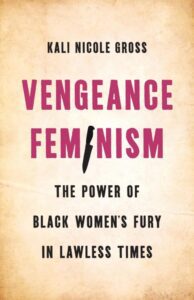
In the early summer of 2025, the nation became aware of the story of Adriana Smith, a Black woman from Georgia, who was forcefully placed on ventilators to keep her and her fetus alive after she suffered a medical emergency and was declared brain dead months earlier. In the weeks after Smith’s story was first brought to light, Black women lamented their disposability and expressed their anger at the complete disregard for the wishes of Adriana and her family who did not want her to lay as an incubator for months. The strict abortion bans in Georgia and other states after Roe v. Wade was overturned in 2022 have led to the senseless deaths of women of all races, but they are a particular sticking point for Black women who historically have served as reproductive science experiments and currently face the highest maternal mortality rates of all races in the United States. Kali Nicole Gross’s book Vengeance Feminism offers a timely historical playbook for the ways in which Black women have responded to similar criminalization, sexual exploitation, and dehumanization.
Vengeance Feminism uses robust sources—including court and prison records, newspaper articles, and census data—to tell a story of how Black women constructed an intellectual and political framework to strike back against misogynoir. Gross challenges us to take seriously Black women’s rage as a “distinct feminist logic” that helped them to gain some semblance of justice (10).
The specific women that Gross studies shirked respectability politics because they knew that most of the time they would not be respected anyway. Gross writes, “How they affirmed their womanhood far exceeded anything that I had ever learned about or considered within traditional definitions of white or Black feminist activism. Black women have been so castigated and caricatured for being angry that many of us have been trained not to express it” (10). Many, unknowingly or not, used the stereotypical roles society placed upon them as a way to express their fury and frustrations at the lawlessness they faced, which Gross defines as the “misogynoir erected and sustained by biased laws and their antiblack enforcement through unequal policing, adjudication, and confinement” (11).
These vengeance feminists did not hesitate to enact violence against those who had wronged them. Gross takes the reader on a thematic journey through nineteenth- and twentieth-century Philadelphia where we meet Black women protecting their honor, stealing from men who presumed they were sex workers, and claiming their bodily autonomy—oftentimes with deadly results. Gross does not sensationalize their acts of violence. Rather, her powerful intervention is her insistence that we take these women’s actions seriously as an intellectual strategy they took against individuals as well as the state. In chapter 2, “Their History: Lawlessness and Black Womanhood,” Gross chronicles the laws and legal practices passed during slavery that harmed Black women for centuries and served as the motivating force for their resistive strategies against the measures that shaped their everyday lives. History is filled with stories of Black men tried for crimes they oftentimes did not commit and how all-white juries convicted them within hours if not minutes. Black women also fell victim to this unequal legal system, and in this chapter, Gross traces the history of laws governing race in the seventeenth and eighteenth centuries to show how they created longstanding beliefs that shaped Black women’s relationship to the state for centuries to come.
 In the 1660s, the English colonies in North America changed their laws to account for the number of mixed-raced children being born from white men’s sexual assault of the Black women they enslaved. As time passed, so did laws that ruled the rape of Black women and girls as, effectively, not a crime. These laws left them vulnerable to both white and Black men while simultaneously fueling widespread beliefs that Black women themselves were hypersexual and even unrapable. Gross introduces us to an enslaved woman named Celia who murdered her enslaver in 1855 after he had sexually assaulted her. Her lawyers argued that the law protected enslaved women from sexual assault by white men, but the court disagreed and sentenced Celia to hang. Celia’s case is one of countless instances of Black women “confronted with American justice: it failed to protect them when they were victims and wielded the worst punishment against them when they were convicted” (60). Gross chronicles cases of how the legal system that maintained slavery fostered myths of Black women’s licentiousness and criminality, which “contributed to a kind of policing and state surveillance that always left them more likely to be searched and harassed, in ways that white women and girls never had to contend with” (60).
While the tales of crime that Gross tells are often grim, their importance to the overall argument is not lost within their broader historical implications. Readers are immersed in a Philadelphia that Du Bois described in his famous The Philadelphia Negro (1899). The growth of the city’s police department directly coincided with the influx of Black migrants to the city. Black people’s increased mobility due to the developing transportation system, for example, expanded their public presence, and thus Black women’s chances to encounter harassment. In chapter 4, “Their Games: Black Badgers, Better Days, and the Limits of Fury,” Gross introduces Black badger thieves. These women “found ways to take advantage of the sexual stigmas to lodge their own assaults on men seeking to debauch them” by pretending to be sex workers in order to rob would-be customers (114). Readers come away with a vivid understanding of the everyday lives of Black Philadelphians and how Black women fought for themselves amid the challenges they endured.
Perhaps most provocatively, Gross undertakes the subject of abortion and infanticide as a resistive approach to the economic and social burdens Black women faced in chapter 5, “Their Dead: The Three Marias and the Babies in the Privy.” Maria Waters, the first Maria in the chapter, was a sixteen-year-old domestic who gave birth while at work. She disposed of her infant son in an icy privy, where he was later found and revived. The other two Marias, another Maria Waters and Maria Harris, both died after seeking abortions. Waters took herbs and Harris obtained a surgical procedure. Their desperation is clear—these acts often led to death or the criminal legal system. Gross posits that these women’s choices were also marked by rage for the societal stain and economic burden Black women particularly faced as unwed mothers. She notes, “Whereas their lives could be reduced to tatters in the shadow of these unwanted fetuses and newborns and the obvious evidence of premarital sex, the men and boys who fathered such offspring often had far less to worry about” (145).
In lieu of direct accounts from the women who sought out abortions or committed infanticide, Gross asks readers to consider what their actions made plain: “As much as these responses to unwanted pregnancies were an attempt to elude undue financial burden and public condemnation, there was also a different kind of political consciousness at work—one that viewed their own lives as more important than motherhood or the lives of the newborns” (147). In a world that debased Black women as hypersexual, as inherently criminal, and that failed to protect them, vengeance feminists resisted by exercising their bodily autonomy—however shocking.
Vengeance Feminism is an important contribution to Black women’s intellectual history. Gross also intervenes in several other historiographies including the history of medicine and the study of Black criminalization and the carceral state. Readers are presented with rich areas of potential academic inquiry such as nineteenth- and twentieth-century Black abortion practitioners and uncovering more Black vengeance feminists.
*This essay was originally published in Vol. 2, Issue 1 (Spring 2026) of Global Black Thought. Copyright © 2026 AAIHS.
Copyright © AAIHS. May not be reprinted without permission.