
Author’s Response: The Power of Black Women’s Fury
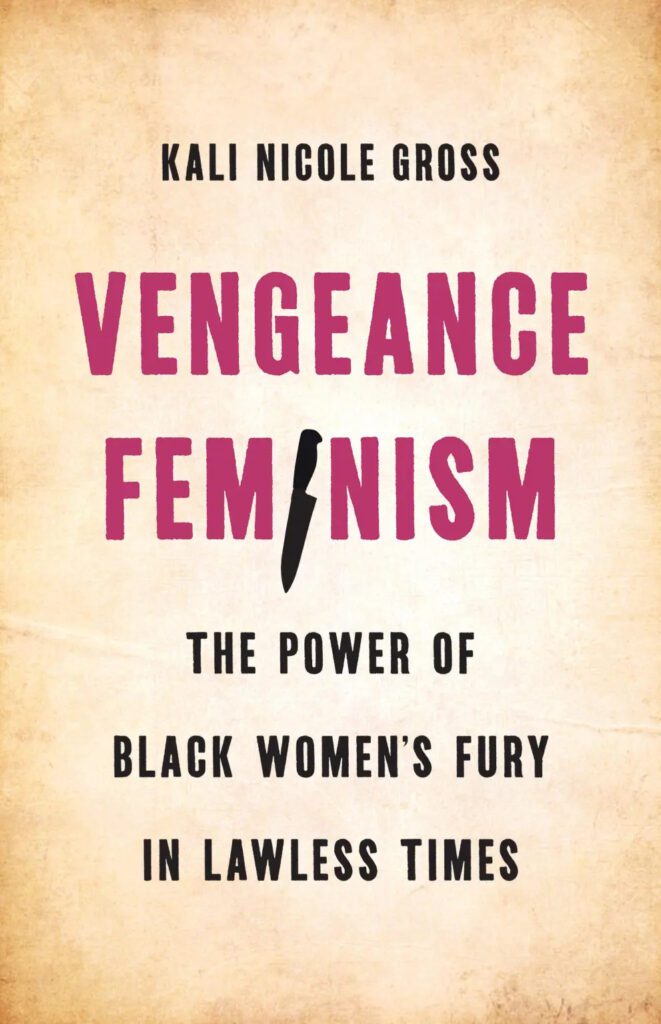
I am indebted to the scholars who read Vengeance Feminism: The Power of Black Women’s Fury in Lawless Times (Seal, 2024) for this forum. They have raised interesting questions and offered generative observations about its contents. I am also grateful to Global Black Thought for curating these pieces. My essay will blend responses to their work with a meditation on the challenges of writing a book like this.
Among my published books to date, Vengeance Feminism was the most difficult to write. I literally wept writing some of the sections—particularly the afterword. At other times, I laughed out loud—like when a sister reportedly knocked out a teen who blew cigarette smoke in her face as she strode past him. It began as an article, but like foliage coming to life in spring, it grew, swelling and blossoming wildly as it branched out and its leaves emerged, dark green and lush. For months it existed as both my garden and my tormentor. Many of the accounts are messy and violent, and in many respects dangerous.
Even so, I carefully tended to the stories. I was inspired by accounts of Black women who didn’t fret over whether hitting back was the “right” response to the various outrages committed against them, and by how they unabashedly acted in defense of their own truths on behalf of themselves. They opened new avenues of inquiry for me, as their cases gave me a chance to contemplate the political, intellectual, and historical importance of Black women whose resistance did not focus on serving the community or rescuing all humankind.
In this sense, for many it is (and will be) a deeply unsettling book. I knew readers would disagree with the notion of violence as any sort of feminist practice—let alone one wielded by Black women, as Sophia Evangeline Gumbs gently gestures toward in her prescient question, “If there is indeed room for violence and vengeance in Black feminism, as Gross has suggested, what might this mean for contemporary understandings of reproductive justice?” The latter part of the query pertains to the notion of reproductive retribution—a concept I introduce and wrangle with in the fifth chapter, by wading through the carnage of illegal abortions, infanticide, and baby farms. I tried to hold a space for Black women to be furious at the myriad hypocrisies and deadly double standards that jeopardized their lives when faced with unwanted pregnancies. It’s a discussion that haunted me as I wrote it, but the legacy of my mother, who survived a botched abortion in her teens, buoyed my efforts. Antionette Burton gets to the heart of this when she wrote, “In a searing Afterword, Gross tells us that her mother’s experience was foundational to how she conceptualized vengeance feminism as both a subject of historical and a methodology for realizing the visibility of Black women who pulled no punches to guarantee their survival and flourishing—and even their pleasure.” Yes, to this. And yes to more conversations grappling with contemporary notions of reproductive justice and retribution.
Writing a charged book in an open-ended manner is also not for the faint of heart. As Cheryl Hicks keenly points out, “[Gross] is also honest about the fact that while she is fascinated with these women’s lives (she adores unruly Black women), she continues to ‘wrestle with the full import of vengeance feminism’.” I did, and I continue to do so. At an Intersectionality Research Salon for the Intersectionality Training Institute earlier this year, one of the participants asked whether we might think about vengeance feminism as a verb. I loved this idea, and I appreciate how the verbification developed in a space that connected folks who deftly grasped and engaged the centrality of Black feminist histories while simultaneously using them to ignite Black feminist imaginaries.
Vengeance feminism, at its core, is a counterpunch—a way for Black women to lash back and take revenge to escape total victimization.
DaMaris B. Hill unpacks this beautifully when she writes, “Black women shared an understanding that Philadelphia was not committed to fulfilling the social contract many white and male citizens enjoyed [and] associated with democracy.” Exactly. For many, that will not be satisfying, holistic, or instructive. So much of how we think about Black feminism is rooted in an ideal of the collective advancing toward this ever-elusive concept of communal justice, that a swift kick to the balls of a would-be attacker might not seem to carry much weight, never mind having ideological heft. But for me, there is great value in what Tracey Johnson describes when she writes, “Readers come away with a vivid understanding of the everyday lives of Black Philadelphians and how Black women fought for themselves amidst the challenges they endured.” In absence of formal protection, they did what they could for themselves—often at great personal risk. I really love that the book recovers some of this.
I wanted to produce a nuanced, vibrant, engaging, and evocative history about Black women who did not “take tea for the fever,” as my late mother would have said. I wanted to enliven history with prose that pulsated. I wanted to paint pictures of seedy parlors that stank of day-old booze, sweat, and post-coital funk. And I strove to do so using available historical resources. I also wanted to challenge myself—to be bold and unflinching in sitting with often-harrowing information. As Jenn Jackson noted, the book “rescues the fullness of Black womanhood from stereotype and caricature.” It was not easy to do. It demanded meticulous pruning, and hypervigilance when it came to pulling out weeds of self-doubt and fear. This isn’t a safe book. It isn’t a celebratory book in the expected sense. It’s angry and vindictive, and it venerates a level of nihilism that often made me queasy.
Writing Vengeance Feminism compelled me to stretch myself to grow as a thinker, researcher, and writer. I had to revisit scant archival documents with fresh eyes; it was a journey that I did not take alone.1 I sought the wisdom of a bevy of sister-scholars, women whose candor and generosity did not just distill the project, but also served as poignant models of how to remain rigorous yet kind and dedicated to the work of this profession. It has been a chaotic, emotionally wrenching ride—one I highly recommend.
*This essay was originally published in Vol. 2, Issue 1 (Spring 2026) of Global Black Thought. Copyright © 2026 AAIHS.
- I must again thank the following scholars for their kindness and generosity as they read drafts of Vengeance Feminism: Nichole Burrowes, Brittney Cooper, Erica Armstrong Dunbar, Aisha Finch, Rhonda Frederick, Cheryl D. Hicks, Talitha LeFlouria, Jennifer Nash, Samantha Pinto, and Rhonda Y. Williams. I remain indebted to my late mother, June Maria Gross (1941–2017); you gave me everything—I love you and I miss you every day. ↩

Thank you for this insightful look into your own work. I will make a point of reading Vengeance Feminism. There’s so much to learn from it.