
Author’s Response: African Americans, Sudan, and the Politics of Solidarity
This post is part of our online roundtable on Christopher Tounsel’s Bounds of Blackness.
In April 2023, civil conflict erupted in Sudan between the paramilitary Rapid Support Forces (RSF) and the Sudanese Armed Forces (SAF). While numbers alone never convey a war’s human toll, the statistics testify to the horrific sequence of events that has unfolded. More than eleven million people have been displaced, thirty million people require humanitarian assistance, and former U.S. Envoy for Sudan Tom Perriello has suggested that the war has taken 400,000 lives.
One of the biggest stories that has emerged from the war has been the media’s comparative lack of coverage of Sudan compared with crises in other locations like Ukraine and Gaza, with World Health Organization director Tedros Ghebreyesus going so far as to claim that the world’s neglect is based on racism. Amid the perception that racism is responsible for the media’s lack of coverage, African American media platforms including BET and The Final Call have reported on Sudan, Rep. Sydney Kamlager-Dove has called for the international community to do more to increase the underfunded humanitarian response, and entertainers 6lack and Summer Walker have leveraged their celebrity status to keep eyes on the situation. Such engagements are not only significant within a broader context of international failures to report on and address the crisis, but they are also the latest chapter of Black America’s century-long history with Sudan—a history that, with its ebbs and flows, teaches much about transnational solidarity in the African Diaspora.
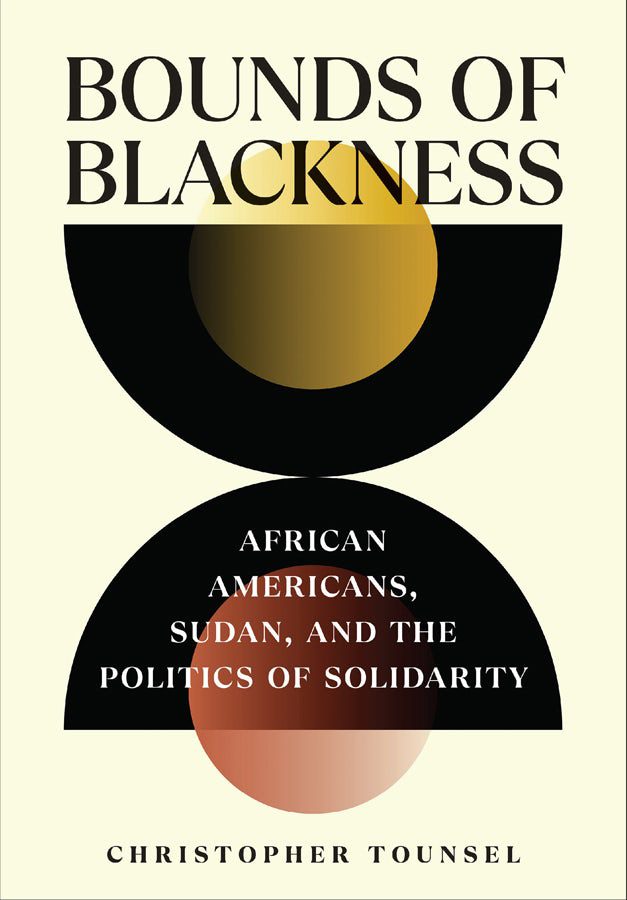
Beginning with Anglo-Egyptian colonialism and concluding with the Obama presidency, Bounds of Blackness: African Americans, Sudan, and the Politics of Solidarity explores the political auspices of African American engagements with Sudan. Through periods of colonialism, postcolonial civil wars, genocide in Darfur, and the secession of South Sudan, Black Americans have had vacillating approaches to the Sudanese state and its multiethnic peoples. I argue that the central theme in this history concerns the question of who African Americans define as “Black” beyond America’s shores, the terms of this endearment, and the consequences of exclusion. By exploring the work of African American intellectuals, diplomats, organizations, and media outlets, this transnational relationship is a lens into the robust yet capricious terms of racial consciousness in the African Diaspora.
In many respects, I wrote Bounds of Blackness in response to an historiographical emphasis that Nemata Blyden identifies—that scholars looking at African American encounters, influence, and engagement with Africa have often privileged West Africa and South Africa over other regions of the continent. The reasons for this concentrated coverage may be understandable on account of ties to slavery and the slave trade (binding the U.S. and West Africa together) and apartheid’s similarities with Jim Crow (explaining interest in South Africa). This logic, however, does not eliminate the dangers of emphasizing certain peoples and areas in Black Diaspora Studies over others. Blyden’s “But what of other regions on the continent?” question is not only one of intellectual consequence but carries practical import as well. As Chresfield rightly posits, “When Blackness is too tightly linked to a particular register of oppression, it becomes difficult to imagine Black people as wielders of power, let alone as perpetrators of harm.” For millions of descendants of Euro-American slavery like myself, it is easy to approach white supremacy–with its elements of slavery, political disenfranchisement, economic exploitation, and terrors of sundry forms–as the dominant cause of Black agony. Likewise, it is evident that the fight to destroy that beast must necessarily continue until freedom is won. In defending oppressed communities throughout Africa and the Diaspora, however, those who claim to don the Pan-Africanist mantle are charged with confronting those members of our own global Black communities who have used their social, economic, political, and military might to harm others of African descent.
It is in this spirit that I appreciate Kimberly Hill’s reference to the way that my book’s arguments “remain meaningful as American journalists work to explain why U.S. citizens should stay informed about deportation policies and foreign affairs.” In 2025, millions watched in horror as U.S. Immigration and Customs Enforcement (ICE) descended upon cities like Chicago, New York, and Los Angeles to arrest those suspected of having undocumented status. Within this perilous landscape, African migrants report being targeted for detention and deportation due to racial bias. Many have used their smartphones to record these arrests, the behavior of ICE agents, and ad hoc attempts to prevent these arrests. While these recordings, in turn, circulate widely on social media and are replayed on major news networks, the circumstances abroad that led refugees to seek asylum in this country garner significantly less attention in the Western media landscape. What results, then, is a necessary understanding of the injustices associated with deportation policies (ranging from medical neglect to the inhumane use of full-body restraints) but relative ignorance of the foreign affairs aspect (namely, state-sponsored abuses occurring in their countries of origin).
To be sure, those African American individuals and organizations who have decided to advocate for the rights and humanity of African immigrants operate in the best tradition of Pan-Africanism’s aim to fight the exploitation and dehumanization of African people. However, roughly sixty years after many of Africa’s former European colonies became independent states, should the same principle be marshaled against Black, postcolonial African governments? As the vast majority of African immigrants in the United States today come from the five countries of Nigeria, Ethiopia, Ghana, Kenya, and South Africa, how should Black American Pan-Africanists respond to issues that include government restrictions on freedom of assembly in Nigeria, abuses conducted by government security forces in Ethiopia, anti-LGBTI legislation in Ghana, Kenyan authorities’ crackdowns on protest leaders and activists, and police brutality in South Africa. With specific respect to the current drama and trauma concerning U.S. immigration, how should Pan-Africanists respond to the reality that several African nations–including Ghana, Eswatini, Rwanda, South Sudan, and Uganda–have received (or have agreed to receive) third-country nationals deported from the United States? Can Pan-Africanism accommodate both zealous defense of Africans against white supremacy and, at the same time, adamant stances against oppressive African governments?
It is in this vein that I appreciate Michell Chresfield’s reading of Bounds of Blackness as a reminder that the most impactful solidarity results from a frank reckoning with power and difference. As I explain in the book, African Americans like Samuel Cotton and Joe Madison shined a light on the existence of slavery in Sudan. Rather than seeking to critique Bashir for self-serving, neocolonial purposes, Cotton and Madison were compelled by a concern for Sudanese that were being persecuted under his watch. In 2026 and beyond, African Americans eager to raise their engagement with and awareness of Africa may ask themselves the following questions: What African leaders and/or governments need to be held accountable for mistreating their citizens?
Sudan represents an important case study because it involves a type of social oppression that is neither exclusively nor predominantly linked to European understandings of race and whiteness. As the white European flags of France, Britain, Portugal, Italy, Germany, Spain, and Belgium waved over enormous swaths of Africa, Sudan–as the Anglo-Egyptian Condominium–was unique in that it was subjected by both a white European colonizer (Britain) and African country (Egypt) at the same time. Added to Sudan’s distinguishing form of colonialism is its demographic diversity. As Brenda Gayle Plummer notes, Black and Arab identities–when considered in a debatable paradigm that links North Africa to the Middle East rather than sub-Saharan Africa–differ from Western understandings of race, where racial ambiguities, social differences, and religious diversity undermined a white/Black binary that Western viewers may more easily discern. However, given the history of Sudanese racial ideologies and racism, Plummer recognizes that “scholars cannot ignore the stark fact of deeply embedded prejudices of early origin that continue to associate Black skin with heathenism and savagery that predate the modern European presence.”
How, then, did African Americans articulate solidarity with an African context that did not experience the more legible type of exclusively white colonial domination experienced by most African nations? How, furthermore, did Black Americans practically learn about an African context beyond the register of race-based transatlantic slavery?
In our collective pursuits of promoting African history and, in the spirit of Pan-Africanist inclusivity, advocating for the interests of the entire African Diaspora, a productive problem arises. What happens, asks Blyden, when Black Americans encounter a society where their notions of Blackness “are complicated by religion, culture, or a reluctance to adhere to American ideas about race and Black American ideas about what Blackness is?”
My research shows that for much of the twentieth century (and into the twenty-first), Black Americans learned about Sudan from a variety of sources including Black-run media outlets, travel narratives, and public forums. From the Chicago Defender to William Leo Hanbserry’s courses on Ancient African civilizations at Howard University; reports from correspondent Joel Augustus Rogers to the travel narrative of Eslanda Goode Robeson; the pages of Jet magazine to talk radio shows in New York and Washington, DC—those interested in learning more about Sudan had an array of information sources at their disposal. Importantly, these sources included Black educators, Black media, Black elected officials, and Black religious leaders.
Much has changed, no doubt, in the ways African Americans consume news (generally speaking) and information about Africa specifically, and there is reason to lament the decline of those Black media platforms that Robert Abbott, Claude Barnett, and John Johnson once shepherded. However, it is my hope that Bounds of Blackness is not read as a memorial to a bygone era of African American engagement with the ancestral continent, but, instead, as a blueprint for the ways that Black Americans can continue to fan the flames of Pan-Africanism by staying informed about contemporary Africa. The history in my book shows that African Americans have never been forced to rely on white individuals, spaces, or organizations alone for information about what was happening in Sudan. I believe that this history can serve as a model and impetus for Black students, scholars, activists, and others interested in learning more about Africa in our ever-evolving information landscape.
Academic organizations with significant Black memberships like the African American Intellectual History Society (AAIHS), Association for the Study of the Worldwide African Diaspora (ASWAD), African Studies Association (ASA), and National Council for Black Studies (NCBS) can continue to hold the line in promoting and disseminating new work on Africa and the African Diaspora in their respective journals and meetings. We can download and listen to past and current episodes of the Mellon-grant sponsored Black Studies Podcast, the New Books Network podcast episodes on the newest books coming out in Africana Studies, and Professor Mark Anthony Neal’s Webby Awards-nominated Left of Black web series (now in its fifteenth season). Rather than relying on the traditional news conglomerates that dominate the Western media space, we can avail ourselves of online news platforms like allAfrica.com—which distributes news and information from over one hundred African news organizations—to help us stay informed on African affairs. When we want to find quick, accessible, and trustworthy information about African history or culture online, we can purposefully decide to skip AI search engines and, instead, comb through websites like Black Perspectives, Africa is a Country, and BlackPast.org—the world’s largest online (and completely free!) encyclopedia of African American and Global Black history and the brainchild of my venerable late colleague, fellow University of Washington historian Quintard Taylor. Finally, there are those information resources that have stood the test of time and continue to show their value: Africana-facing talks and events on college campuses; high school and college courses that explore Global Black history; peer-reviewed journals that protect, preserve, and defend the premise that Black history and culture is worthy of examination; and–in our rapidly-changing information environment–books.
By creating, promoting, and availing ourselves of such sources of information, we can not only take up Blyden’s push to engage with “the sometimes messy and unpalatable aspects of post-independence African countries, even those with whom we might not have a historical connection,” we can also resist the tendency to favor certain countries of study in global African American history.
All countries–or, within the context of this discussion, traditionally marginalized African countries–can be more seen, their problems more understood, and, in times of crises, more likely to receive our support. The inconvenient truth is that some African countries are less visible in the African American gaze and, as such, are less likely to be seen, understood, and included in the Pan-African paradigm. At a moment when humanitarian emergencies in countries like Cameroon, Mozambique, Somalia, and Uganda find themselves on the Norwegian Refugee Council’s “most neglected displacement crises” list, it is clear that the entire continent demands our scholarly and activist attention. Without said attention and understanding, solidarities that are pivotal for surviving times of crises are difficult, if not impossible, to build. I am not suggesting that African Americans’ time-honored focuses on West and Southern Africa should decrease, rather, I reiterate my belief that we must confront the realities that U.S.-based Pan-Africanism has historically been a regionally selective one.
At the time of this writing, the SAF and RSF are writing new Sudanese history in blood as their war rages on. While it is important to critique Western nations, institutions, and media organizations for failing to meet the moment with the urgency it demands, it is also necessary to highlight the ways that one community—African Americans—have engaged with Sudan for more than a century. From the Tuskegee Institute graduates who performed agricultural work in the early 1900s, Black newspaper coverage of the country’s colonial subjugation, U.S. foreign service worker Arthur McCaw’s work to steer U.S.-Sudan relations in its early postcolonial days, and Howard University’s decision to divest from Sudan following the genocide in Darfur, African Americans have provided models for what engagement with Sudan can look like. This history has much to teach those who want to understand and respond to the current crisis.
*This essay appears in Vol. 3, Issue 1 (Spring 2027) of Global Black Thought. Copyright © 2026 AAIHS.
Copyright © AAIHS. May not be reprinted without permission.