
The Black Intellectual Traditions That Shaped Frederick Douglass
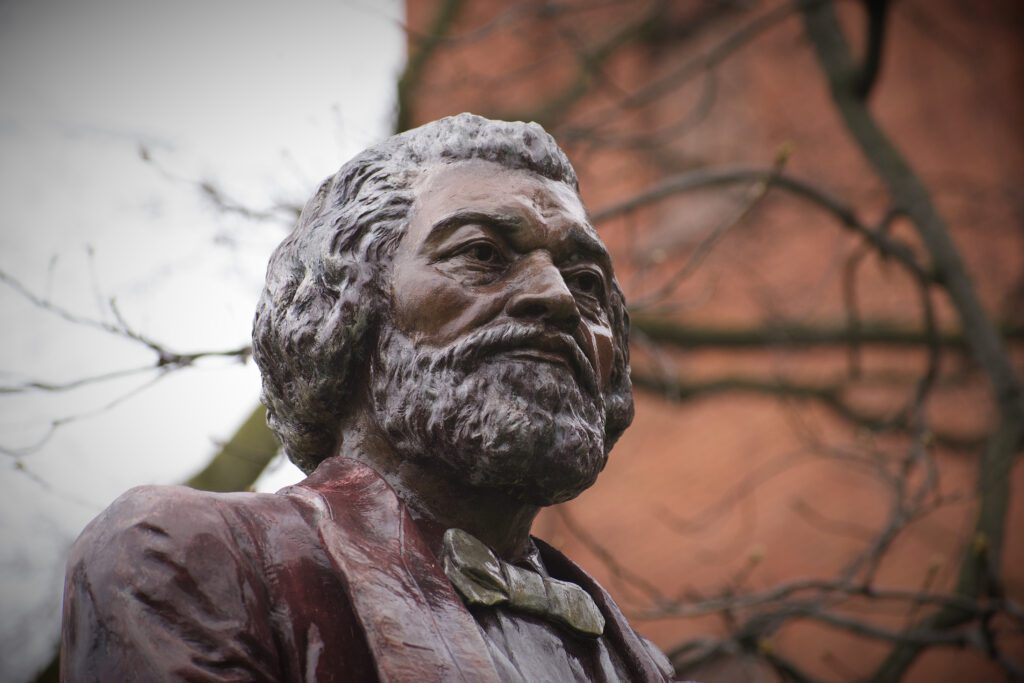
The United States recently marked 250 years since the adoption of the U.S. Declaration of Independence. For this occasion, a quote has been circulating from Frederick Douglass: “This Fourth July is yours, not mine. You may rejoice, I must mourn.” Most Americans will hear it as proof that the Republic bends; a Black man at the lectern holding the country to its founding promises. That reading has scholarly backing. Waldo Martin places Frederick Douglass’s mind inside Protestant Christianity, the Enlightenment, and romanticism. Nicholas Buccola calls him a “philosophical statesman” devoted to self-ownership and liberal individualism. Both readings have real evidence behind them. Douglass had read Locke and Jefferson, and he handled their language like someone who had earned it.
But what Douglass argued is a different question from how he argued it. Where did he learn to time a silence, work a pronoun, and drop a Bible verse on a crowd that did not see it coming? Not in any library in New York. He learned it earlier–on the Eastern Shore of Maryland and in the streets of Baltimore among people whose names the country does not remember.
We miss this because the standard methods of intellectual history privilege the printed page: treatises, periodicals, and lectures preserved in pamphlet form. Applied to Douglass, those methods produce someone who read and quoted other men of letters. But, they have less to say about the Sabbath schools, the secret prayer meetings, and the spirituals created by enslaved people that shaped how Douglass thought a public argument should sound. Recovering that lineage matters because it changes who counts as a thinker. It places enslaved communities into the historical record as sites of intellectual production in their own right rather than as material for someone else’s philosophy.
Some of the sharpest cultural analysis in nineteenth-century American writing sits in a few pages of My Bondage and My Freedom. Douglass describes the songs he heard as a child on Colonel Lloyd’s plantation. They were, he writes, “jargon to others, but full of meaning to themselves.” That clause is this whole argument in miniature. The same sound carried two registers–opaque to the enslaver, transparent to the singer. Looking back, Douglass insists he now understands what he could not understand as a child: “Every tone was a testimony against slavery, and a prayer to God for deliverance from chains.” Northerners who took the singing for happiness had failed to read the songs at all.
Lawrence Levine’s Black Culture and Black Consciousness gives us the framework to hear what Douglass is saying. The spirituals, Levine argues, built a world for enslaved people, a world in which the Old Testament was the place where they actually lived. Albert Raboteau’s “invisible institution” shows how the building got done: clandestine meetings in the woods, kettles turned over to swallow the sound, a religious life that enslavers could neither see nor own. Sterling Stuckey traces the ring shout and the antiphonal song to West African ground and argues that they carried a coherent political consciousness with them across the Middle Passage.
Douglass walked through this world. Charles Lawson, an old free Black drayman and lay preacher in Baltimore (whom Douglass also calls “Father Lawson” and “Uncle Lawson” in My Bondage), taught him “the spirit” of Christianity while Douglass taught Lawson “the letter.” Lawson told the boy the Lord had chosen him for some great work, and Douglass writes that the conviction set his thoughts on “a channel from which they have never entirely diverged.” The phrase is worth holding onto. Douglass is naming the source. The orientation of his adult mind was set by an unlettered Black preacher who could barely read.
If we listen to the speech with that lineage in mind, the rhetorical machinery comes into focus. Henry Louis Gates Jr. once called Douglass “a masterful Signifier,” a practitioner of the Black tradition of repetition with a difference, of taking your opponent’s words and giving them back so changed they cut. Gates traced the practice to the spirituals themselves. The Fourth of July speech is the loudest performance of that tradition in American oratory.
Start with the pronouns. The speech opens like any other patriotic address. But listen for the possessive: “your National Independence,” “your political freedom,” “the birthday of your national life.” Never “our.” For pages, the audience hears it without hearing it. Douglass walks them, slowly, to a place they have not realized they are going. By the time he arrives at “This Fourth July is yours, not mine,” forty minutes have prepared the ground for his audience. He is doing on a national stage exactly what he had described the spirituals doing in the Maryland woods.
Then, he reaches for Psalm 137: “By the rivers of Babylon, there we sat down. Yea! we wept when we remembered Zion.” The psalm builds toward the question that breaks the room: “How can we sing the Lord’s song in a strange land?” In one move, Douglass has put enslaved Black Americans where the Israelites stood and his white audience where the Babylonians stood. He had been invited to sing a national song. He has answered with the voice of the captive who refuses.
Then he names what he is doing. “At a time like this, scorching irony, not convincing argument, is needed.” He will not lay out propositions. He will preach: “It is not light that is needed, but fire; it is not the gentle shower, but thunder. We need the storm, the whirlwind, and the earthquake.” That is the language of the jeremiad, of the sermon preached in the quarters, of every Black preacher who ever called down judgment on enslavers from a hush harbor. The climactic question follows: “What, to the American slave, is your 4th of July?” The answer rolls out in parallel clauses: “Your boasted liberty, an unholy license; your national greatness, swelling vanity; your sounds of rejoicing are empty and heartless.”
Those parallel clauses do real argumentative work. They are the structure of call-and-response, the central architecture of Black sacred performance. In the ring shout and the praise meeting, the preacher’s call carries authority only as it is answered, amened, lifted, and embodied by the congregation. The form is dialogic on principle. Douglass imports it into Corinthian Hall and applies it to a white audience that lacks the liturgical training to participate. Each clause is a call demanding a response the room is not equipped to give. The silence that follows carries the indictment.
Saidiya Hartman has reminded us that the politics of Black suffering performed before white audiences are never innocent. Douglass had been on the lecture circuit long enough to know what it cost to perform his wounds. What he does at Corinthian Hall goes further. He brings the techniques of the enslaved community into the room and uses them to refuse the role the room had picked for him. The constitutional defense at the end of the speech belongs to this same project. It is the philosophical statesman speaking, after the preacher has done the hard part.
In 2026, Douglass is on banners and at podiums. He will be made to say the founders were greater than they knew. He will be made to say the Republic’s wounds carry their own cure. The speech does end in hope. But the Douglass who got to that hope passed through Babylon to get there, with the songs of Colonel Lloyd’s plantation still in his throat. Sterling Stuckey wrote that the folklore of enslaved people was the most powerful expression of the moral argument for ending slavery, and that Douglass was its best student.
Miss the vernacular roots of the Fourth of July speech, and you miss why it has lasted. The voice that turned the Declaration into something different in 1852 belonged, first, to the people Charles Lawson prayed with in Baltimore and to the men who walked the road to the Great House Farm singing songs the enslavers never learned to hear. The intellectual history of American freedom has always run through quarters and hush harbors as well as libraries and lecture halls. That is the lineage worth claiming on the country’s 250th birthday.
Copyright © AAIHS. May not be reprinted without permission.
Greetings Mr. Crosthwait:
Definitely want to express gratitude at the opportunity to read and take in your very enlighten article entitled.
“The Black Intellectual Traditions That Shaped Frederick Douglass”
As the 21st Century “FREDERICK DOUGLASS” Proudly for the last 17 years.
In concluding of reading this awesome article, I commend you for touching on Mr. Douglass and the great speech: “What to the Slave is the Fourth of July!” Plus shinning light on portions of it that bring to reality valid points he made clear as to why “this holiday is theirs and not ours.” 250 years of this country marked on the calendar, and it is still their celebration!!! In this project 2025 political climate, we the majority of “we the people” are stuck in downtrodden displeasure.
When Mr. Douglass mention “it is not light that is needed, but fire: it is not the gentle shower, but thunder, we need the storm, the whirlwind, and the earthquake! That speaks to our current disparities taken place.
Mr. Douglass achieved many milestones during his essential walk through his life. From his time with Mr. Lawson who told him as a youngster the Lord had chosen him for some great work, to his September 3rd escape to begin his great work, until his last day at the Washington Covention Center. This is where Mr. Douglass would make his last stand with Susan B. Anthony and other great women of the time. Upon returning home on that February 20th evening of 1895, he would be held by his second wife, Helen Pitts as he expired.
“FREDERICK DOUGLASS” name rings an distinctive bell that I am grateful to have been commissioned to pick up the barton and carry his words and work forth in the 21st Century.
It truly is an Honor, and your article truly is an Honor to read and comprehend!
Thank You Sir!!