
Framing Black Women’s Lives in Philadelphia

I am a multigenerational survivor of domestic terror in the United States, most of it north of the Mason Dixon Line or in states that sided with the Union during the American Civil War. I may have something like Post Traumatic Stress Disorder; I have reoccurring memories of collective and individual violence interrupting my waking moments. Some might believe that my peers and I were hostages of the War on Drugs, collateral damage to the cocaine-induced ‘yuppie’ anti-Blackness that was stimulated by greed and the undocumented economies associated with the 1980s that funded two decades or more of the Cold War and/or proxy wars between the Soviet Union and the United States. During that time, I was a kid like the Exonerated Five, those Black and Brown boys they called a ‘wolf pack” in the New York Times. They never called us children “the enemy within” in the media, but they propped us up to be super predators. They stuffed the prisons with Black and Brown kids, some of them young women they call “bitches.” Within a short time, prisons look more like plantations. Twenty years and two college degrees could not save me from the propaganda of super predator preteen image. There is a warrant out for my arrest rooted in a speeding ticket. As I am preparing to train 700 middle school teachers to teach reading to middle school students in Baltimore City Public Schools, six or more officers run into my house, because of this speeding ticket type warrant and arrest me for missing court. Of course, I was speeding. Single mothers are always rushing off to work. Being a single mother is the largest determinant of poverty in the United States. With a master’s degree, a teacher’s salary, and a part-time job as a military service member, I am the sole provider of a household, and I am poor. Poverty is synonym for criminality in America.
I am three degrees in and anxious all through to my ribcage. Knowledge is a type of armor. I have long made a close study of Kali N. Gross’s scholarship. My first introduction to Gross’s work was reading Colored Amazons: Crime, Violence, and Black Women in the City of Brotherly Love, 1880-1910 (2006) in 2010. Colored Amazons impacted me greatly. I felt the case studies Gross documented in my body and, later, in my collective memory. Gross’s book influenced my scholarship, creative work, and critical perspectives regarding the intersections of Black women, liberation, and incarceration. The book was so critical to my development it became a type of ekphrasis for my creative work. When I reference an ekphrasis, I mean a type of artistic inspiration for many of the poems that are included in my first full-length poetry collection, A Bound Woman Is a Dangerous Thing: The Incarceration of African American Women from Harriet Tubman to Sandra Bland. In a sense, Colored Amazons is multimodal scholarship, a kind of remix that brings multiple disciplinary perspectives—from anthropology, sociology, and history—into conversation with one another.
I continue to admire Gross for her careful and multimodal interdisciplinary approach to studying the intersections of race, gender, and class in Black women’s history that winds into our contemporary lives.
In my work as a poet and creative scholar, my work is often mismanaged by traditional methodological venues. I mean this to say that traditional methodologies do not always work for me and my research aims. Traditional methodologies are often limited in scope and utility. Often traditional methodologies fail to meet the needs of intersectional analysis requires, particularly in regard to analyzing and documenting how the intersections of race, gender, and class impact the lives of Black women. Vengeance Feminism extends some of the research that Gross began in Colored Amazons. In Vengeance Feminism, Gross has offered somewhat of a solution and a theoretical perspective that reflects the complex intersection of race, class, and gender. Gross’s theoretical perspective adds to the methods of analysis and theoretical canon of Black Feminist Thought, whereby expanding the disciplinary methods of history, particularly Black women’s history.
Vengeance Feminism is inspired by rage, resentment, fear, and anger. Vengeance feminism as a theory is the retaliation against the punishing acts that were initiated by patriarchal, racialized, and gendered privilege. Gross frames the theory in context of intimate partner relationships, sex work, and reproductive choice in Black women’s lives. Although Gross situates the theory in context of Philadelphia, vengeance feminism as a theory can be applied to other geographical places and social circumstances. Vengeance Feminism speaks to the lawlessness conditions that impact Black women’s lives
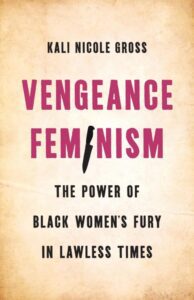 Gross’ new book continues to excavate the complex social conditions that historically have threatened the individual freedoms and pursuits of happiness in Black women’s lives. She is also documenting—using newspapers and court testimonies—the complex capitalist and cultural ecosystem that Black women were forced to navigate in Philadelphia. In doing so, she depicts the relational aspects of Black women’s lives in Philadelphia. These relational aspects are competencies, a set of interpersonal skills that create intimacies (i.e., trust, openness, cooperation, shared goals and visions, etc.) and that result in a group process that liberates people to be authentic in contexts that support fair and just human thriving (e.g., sufficient resources for everyone to thrive, fulfill their assigned responsibilities, and be treated justly, fairly and with respect).1 “Feminist relational theory understands interpersonal relationships as situated in structural relations. . . . We are interested in [the] networks and structures of relationships, as creating the context for the dynamics of smaller scale interpersonal relationships, including partnerships, familial, friendship, and kin relations as well as professional-client, doctor-patient, teacher-student, and other relationships.” 2
These relational aspects and connections created networks of liberation and survival for the women Gross discusses in Vengeance Feminism. Her book begins to excavate and recover those unacknowledged by the dominant culture and those who remain largely undocumented in traditional historical archives. Applying methods associated with historical research, sociology, and anthropology, Gross carefully approaches the archival material associated with the lives of Black women. Using court records, immediate historical accounts from the various newspapers, meeting minutes, and other sources, Gross excavates some of the root causes of criminality in the context of the social and cultural landscape of Philadelphia. The book is also an intimate conversation with scholars like Anna Julia Cooper. Gross notes, “Cooper’s early iteration of Black feminism touches on the societal violence and ongoing miseries that most Black women faced” (121). Her work also cuts against W. E. B. Du Bois’s sociological research regarding Black women in Philadelphia during this era. In doing so, Gross creates a new theoretical lens, vengeance feminism, that examines Black women’s commitment to individual and collective ideas of liberation and personhood within the context of the social constraints of the early twentieth century in Philadelphia. As she demonstrates in her conclusion, the theory also can be applied to the experiences of twenty-first-century Black women who are navigating the intersections of race, gender, and poverty in America.
The book and the theory are in conversation with our contemplations of Black women’s rage as a strategic aspect of surviving patriarchal influences within society that attempt to neutralize Black women’s power and agency.
The analysis and research in Vengeance Feminism is a type of Black woman’s refrain asking, “Where is my safety?” (125). A Black woman’s safety in America, then and now, is constantly being negotiated against the prevailing stereotypes and circumstances that inhibit a life of human dignity and choice.
Those of us who are invested in humanity and justice— and those of us who lamentably are not—need to examine the intricate details of Black women’s choices as they relate to criminality, policy, public sentiment, incarceration, and concepts of liberation. The decisions that enabled these Black women’s individual liberation were often met with extreme violence. Vengeance feminism presents the very queer and complex continuities between liberation and (intimate partner) violence as well as between respectability—and social inclusivity—and the explicit and extensive consequences of rejecting respectability in Black women’s lives.
“Ships at a distance have every man’s wish on board. For some they come in with the tide. For others they sail forever on the same horizon, never out of sight, never landing until the Watcher turns his eyes away in resignation, his dreams mocked to death by Time. That is the life of men.
Now, women forget all those things they don’t want to remember and remember everything they don’t want to forget. The dream is the truth. Then they act and do things accordingly.” – Zora Neale Hurston, Their Eyes Were Watching God
For me, Gross’s work extends some of Zora Neale Hurston’s visionary theories regarding intersectionality, gender, and desire in the context of curating and building a better life. Gross’s theory of vengeance feminism demonstrates how Black women shared an understanding that Philadelphia was not committed to fulfilling the social contract associated with democracy that many white and male citizens enjoyed. They also intimately understood, and their bodies may have remembered, that Philadelphia did not have any intentions of extending the benefits of “brotherly love” to Black women, working class or otherwise. Therefore, many Black women evoked a type of self-reliance, envisioning the life they wanted and making choices that would allow the life they desired to manifest and thrive despite social constraints.
*This essay was originally published in Vol. 2, Issue 1 (Spring 2026) of Global Black Thought. Copyright © 2026 AAIHS.
- lease S. Ferguson and Toni C. King, “Black women’s Relational Competencies and Ethical Leadership in the Workplace,” Journal of Black Sexuality and Relationships 9, no. 3 (2023): 239–272, https://doi.org/10.1353/bsr.2023.0012. ↩
- Christine M. Koggel, Ami Harbin, and Jennifer J. Llewellyn, “Feminist Relational Theory,” in “Relational Theory: Feminist Approaches, Implications, and Applications,” eds. Christine M. Koggel, Ami Harbin, and Jennifer J. Llewellyn, special issue, Journal of Global Ethics 18, no. 1 (2022): 1–14, https://doi.org/10.1080/17449626.2022.2073702. ↩
