
Weapons of the Furious: Vengeance Feminism as “Loving Correction”

Kali Nicole Gross’s Vengeance Feminism: The Power of Black Women’s Fury in Lawless Times opens with the story of how Mary Johnson came to have a hatchet in her hand in October 1886, staving off the blows rained on her head by Edward Snyder, a married man and father of her child. Her act of self-defense—which Snyder survived—landed her in court and branded her a violent woman in the headlines of the Philadelphia Evening Bulletin. From the start, Gross is at pains to situate Mary’s history in the long arc of Black feminism—and to redeem Mary’s recourse to violence as an act of self-protection and vengeance that makes her an undeniable and legitimate part of the ideology’s history. The book teems with similarly powerful examples that offer a rich and textured account of why, how, and under what conditions Black women in the late nineteenth century, activated by their righteous anger, defended their honor and their livelihoods. Gross makes an empirically plentiful and interpretively robust case for counting Mary Johnson and her sisters in the pantheon of Black feminists who challenged the daily systems of oppression they faced. In that sense, Gross restores these women to the narrative of Black feminist history and asks us to reconsider how we think about where—in and outside of the traditional archive—we should look for stories like theirs.
As the opening case suggests, Vengeance Feminism is cinematic in its approach to bringing histories like Mary’s to the fore. The illustrations Gross uses to complement her narrative are drawn from contemporary newspaper accounts of the “outrages” Black women were said to have committed, especially from the trials where many of them attempted to prove their innocence, and they help us visualize the attention they received in their own time. But it’s the way each chapter is organized around, and driven by, the stories of women in Philadelphia and its environs who mobilized “every survival instinct” they had to talk, fight, and flee their way out of interpersonal or legal jeopardy that brings the phenomenon of vengeance feminism truly alive (77). Whether they were in violent domestic relationships, worked the streets as “badgers” to con men out of money under the guise of sexual favors, or sought reproductive justice on their own terms, women like Sarah Ward, Mary Wright, and Ravena Haynes chafed against social mores and took matters into their own hands. They often paid with their lives or paid the high price of incarceration. Gross reads these acts as feminist in nature even if they were not explicitly so in intention. And she links the political and social histories from which they emerged to broader arguments about Black feminism both past and present. Notable is the connection she draws between vengeance feminism and Anna Julia Cooper’s philosophy: “Both systems value Black women and seek to protect and avenge Black womanhood in some way.” As Gross reminds us, the difference here is that the women in her book were not educated nor were they necessarily preoccupied with respectability (though some did make huge efforts to be married, despite the cost to their safety). They had “expert knowledge of violence, violation, deprivation and corruption. Intimately” (122). Gross also understands vengeance feminism to be aligned with Beverly Guy-Sheftall’s definition of Black feminism in her 1995 Words of Fire—that is, as part of a visionary tradition of resistance rooted in discernment of “the interlocking nature of . . . oppression” (7).
To be sure, violence has always been a subject of feminist history. Yet it is rare to receive such a sustained, unflinching investigation into how women, let alone Black women, have appropriated violence at multiple scales to protect and avenge themselves against the dangerous forms of disrespect they encountered in the home, on the street, or in the courtroom.
Indeed, Gross emphasizes that Black women like Johnson, Ward, and Wright exceed the bounds of who has traditionally counted as a Black feminist actor. They used violence and practiced vigilantism. They took up razors, pistols, blackjacks and “balled-up fists”—a whole range of “dirty tricks”—to weaponize their rage against the system and those who controlled it (11). And it’s that rage, which Gross prefers to call fury, that is at the heart of her recovery project. She mobilizes a host of Black feminist intellectual work that precedes and ratifies her claim, including Michele Wallace’s Black Macho and the Myth of the Superwoman (1978), Audre Lorde’s “The Uses of Anger” (1981), and Nikki M. Taylor’s Brooding Over Bloody Revenge (2023). Gross not only demonstrates the necessity of accounting for rage by historicizing it, but also argues for the urgency of grappling with Black women’s response to systems of justice that were, and continue to be, relentlessly “retributive and anarchic” (15). To some extent, their actions mirrored the same retribution and anarchy back toward the system that imposed it on them. It was an uneven contest, but Gross illustrates the importance of excavating their stories, calling out the patterns across them, and rerouting Black feminism through the justice-impacted fury that impelled so many Black women to pursue the lives they deserved.
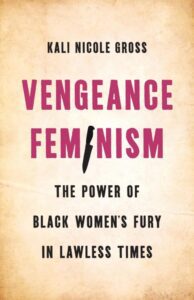 Key to Gross’s project is making women like Johnson and Wright visible and accessible to a plurality of audiences. Her choice of a non-academic press, Seal, as the platform for this history of vengeance feminism is significant. Founded in 1976, Seal is a feminist press that begin in a Seattle garage and is now an imprint of Hachette, one of the biggest global publishing houses today. The book is written in a highly readable style as Gross draws on a vast array of archival and print culture sources to weave compelling plotlines around dozens of women, which draws readers into the deadly serious dramas that unfold across these pages. Excellent at scene-setting, she brings the urban contexts alive—in part because she knows the historic streets of Philadelphia so well and also because she understands the stakes of conjuring the local conditions in which Black women made their fortunes, both materially and aspirationally. For academic readers, some of Gross’s prose will evoke “critical fabulation,” a mode of enhancing archival finds with the feel of the worlds Black women walked and fought their way through.1
For others, the vividness coming off the page will read as much like fiction as history. This is a major accomplishment in my view, not least because the verifiable historical facts are clearly evident even as the filmic quality of the storytelling is so compelling. It’s hard to put the book down. Gross is skilled at navigating the spaces between traditional history and an expansive historical imaginary that keeps the political stakes in view. But she’d be the first to resist any kind of triumphalist narrative. There is more than one occasion when the Black woman at the center of a heart-stopping story of unleashed fury simply disappears from the archive, leaving us stunned and amazed at how quickly murderous rage can be snuffed from the historical record, let alone from the living breathing communities they inhabited and helped to sustain.
The graphic nature of Vengeance Feminism is one of its most distinctive features. As I galloped from story to story and from case to case, it got me wondering about how to teach this material: how to bring it today’s students who will surely recognize in the Johnsons and the Wards of the late nineteenth century the many analogs in their own time—without knowing exactly how best to connect the dots.
What would a syllabus built around Gross’s book look like? Limits of space prevent me from elaborating a full course outline. But drawing on the citationary apparatus in the book, we can imagine a first section that draws on chapter 1 to establish some genealogies for the extralegal actions of women like Ward and Wright by reaching back toward plantation realities, relying on Deborah Gray White’s Arn’t I a Woman (1985), Jennifer Morgan’s Laboring Women (2004), Rachel Feinstein’s When Rape was Legal (2018), and Gross’s own Colored Amazons (2006) as partial context. Given the power of the visual in Vengeance Feminism, Rebecca Hall’s graphic novel Wake (2021) might also be a touchstone. And in light of the speculative mode Gross uses to help us flesh out Black women’s social landscapes and emotional interiority, selections from Toni Morrison’s Beloved (1987) could also find a place here.2
I’m especially keen to think through a class session or two that pairs parts of Gross’s book with Dorothy Roberts’s Killing the Black Body (1997). Though at first glance Roberts’s work would seem to speak most directly to Gross’s chapter on Black women’s and girls’ “deadly efforts to evade motherhood,” the juxtaposition might open up conversations about the ways that race and reproduction are the matrix for understanding the very meaning of liberty for Black women (157). And why histories of how they sought to protect that liberty at all costs cannot be ignored, wherever they lead.
A second section in this proposed vengeance feminism syllabus could dive deep into one or two of Gross’s chapters to hone in on the case studies and mine the footnotes for sources in order to build a picture of how she reconstructed the trial of Mary Wright from a variety of newspaper articles and other primary collections. This would show students how the sausage is made, as it were. Creating lesson plans around some of the imagery reproduced from the media coverage of her case would also help students to appreciate how news of a case like Mary Johnson’s filled community eyes and ears at the time in stark contrast to the way it has fallen off the radar of Black feminist history until now. Assignments could include developing a short-film script for one of the major cases in the book or several panels for a graphic novel that would bring to life the strategic determination that Mary Wright exhibited through a combination of text and visuals. One takeaway here is that the material in Vengeance Feminism is not static—it can be remixed into a variety of mediated forms that appeal to even wider audiences and are driven by students’ own capacity to move history into the present and vice versa.
A final syllabus section could put Vengeance Feminism into conversation with select examples of current Black feminist writing. I’m thinking here of Mikki Kendall’s Hood Feminism: Notes from the Women a Movement Forgot (2020). Published by Penguin, this book is also designed to appeal to a wide audience. It is grounded in Kendall’s story, but she links her autobiography to long and deep traditions of rebellion and explicitly calls for more research that acknowledges and centers her supposition that “young women of color . . . are the only ones invested in their own safety outside their nearest and dearest.” But no syllabus would be complete without grappling with Gross’s invocation of her mother’s example, fury, and spirit. In a searing Afterword, Gross tells us that her mother’s experience was foundational to how she conceptualized vengeance feminism as both a subject of historical inquiry and a methodology for increasing the visibility of Black women who pulled no punches in order to guarantee their survival, their ability to flourish, and, even, their pleasure.
In that sense, Vengeance Feminism belongs on the same syllabus or reading list as adrienne marie brown’s Loving Corrections (2024). Part of AK Press’s Emergent Strategy Series, this text is a primer for those interested in reorienting—or “righting,” as Brown puts it—their fields of vision away from judgment toward “taking responsibility for calling things out” through “experiments in honesty” that name unpleasant truths that need to be countenanced in order to expand the scope of what is legitimate action, not to mention desire. Reading Vengeance Feminism in this frame, we might put the audacity and suffering of the Mary Johnsons of this world to immediate and continuous use, the better to understand who counts as a feminist in the Black community of activists, whether ordinary and extraordinary. We might lovingly correct the assumption that fighting “dirty” to get justice does not have a long, unsung history. In fact, Gross shows us that such history is possible, and urgent, for the struggles of today.
*This essay was originally published in Vol. 2, Issue 1 (Spring 2026) of Global Black Thought. Copyright © 2026 AAIHS.
- Saidiya Hartman, “Venus in Two Acts,” Small Axe 12, 2 (2008): 1-14, https://doi.org/10.1215/-12-2-1. ↩
- Deborah Gray White, Aren’t I a Woman? Female Slaves in the Plantation South (Norton, 1985); Jennifer Morgan, Laboring Women: Reproduction and Gender in New World Slavery (University of Pennsylvania Press, 2004); Rachel Feinstein, When Rape was Legal: The Untold History of Sexual Violence during Slavery (Routledge, 2018); Kali Gross, Colored Amazons: Crime, Violence, and Black Women in the City of Brotherly Love, 1880–1910 (Duke University Press, 2006); Rebecca Hall, Wake: The Hidden History of Women-Led Slave Revolts (Simon and Schuster, 2021); Toni Morrison, Beloved (Alfred A. Knopf, 1987). ↩
