
Fury and Disrepute: Black Women’s Feminism in Lawless Times
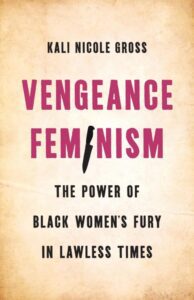
We rarely read stories about unrespectable women. When we do, they are often white, middle class, heterosexual, and cisgender. Unrespectable women in history are typically framed as selfless martyrs whose primary motivations originate from outside of themselves rather than from within. When Black women are framed in unrespectable terms, they are often cast as lascivious villains, the Sapphires and Jezebels whose inner anger emanates from unknown sources rather than from the systemic discrimination, persistent anti-Blackness, unrelenting sexual violence, and the brutal injustices they encounter daily. In Vengeance Feminism, Kali Nicole Gross writes against the innumerable historical narratives that render Black women as either perpetual victims or uncontrollably angry women without direction. Instead, she theorizes a form of feminism that has long existed: vengeance feminism. This feminism, rooted in the lived experiences of Black women, harnesses righteous indignation and legitimate fury to enact all manner of revenge on a world committed to harming Black women.
In this groundbreaking text, Gross offers a reclamation of Black women’s anger, one that contextualizes justified rage and rescues the fullness of Black womanhood from stereotype and caricature. Situated in late nineteenth-century Philadelphia, Gross explores the ways in which Black women’s violent actions “point toward a pattern and ideology not simply of self-defense but also revenge” (6).
These violent actions are not nebulous or without context— they are deeply connected to the communal trauma, isolation, and alienation that force Black women to become their own saviors. Gross writes, “I use fury more often than rage, partly because of its origin in ancient mythologies, tales of fierce female deities that violently administered justice—goddesses of vengeance” (9). This is an anger, Gross explains “that is deeply concerned with justice” (9). This is a critical intervention in Black intellectual history and African Diaspora Studies that follows how previous scholars such as Audre Lorde and bell hooks have offered comprehensive articulations regarding the uses and legitimacy of Black women’s anger. Yet, to date, few works have rooted those assertions in the lived experiences and histories of Black women themselves. Gross shows us how women like Sarah Ward and Lillie Fisher, two women walking with weapons, were strategic in enacting revenge on people they believed had wronged them and tarnished their virtue. As such, Gross’s historical analysis grounds her theoretical claims in little-known stories of everyday Black women whose lives might otherwise remain unknown, unnamed, and lost to history.
 Two critical themes emerge in this text that demand interrogation: the perpetual denial of legal protections for Black women and the limitations of imagination that shape the lives of Black women and children. First, Gross illuminates the ways that de jure laws rarely protected Black women. In the late nineteenth century, the era at the center of Gross’s text, anti-Blackness was not only enshrined in legal statutes regulating marital and labor rights, but also it curtailed movement in public spaces and access to leisure time. Black women’s prior status as chattel also rendered them “unrapeable” in the minds of many white Americans. As such, the injustices of sexual violence were not applied evenly for women of all races. These constraints left Black women vulnerable to the whims of plantation owners even after the legal cessation of slavery as sharecropping and domestic servitude were the primary occupations for Black women in the late nineteenth century. In this way, Gross reveals the ways that legality was but a formality, one that enabled and shielded the anti-Blackness and misogyny of white families, police, and the state. Gross refers to whiteness as an “off-ramp” where Blackness and womanhood were instead informal liabilities. Essentially, all times are lawless times for Black women in a world where legal frameworks are meant to uphold the violent status quo.
Second, a central theme throughout Vengeance Feminism is the preeminence of the white imagination. For many Black women whose livelihoods were predicated on the word and trust of white families, much of their existence revolved around managing the concerns, fears, and proclivities of white people. Gross tells the story of Mary Wright who, after the violent death of her mistress, had to marshal the limited resources she had to strategically shape and influence the ways white Americans perceived her in order to survive. Gross says, “Black women knew that sympathy and compassion would not easily be granted—they had to comport in ways that signaled to jurors they were worthy” (106). Eventually, Wright was acquitted but only after comporting herself to the raced and gendered expectations of the white jurors who controlled her fate. Gross intervenes in broader historical narratives about Black women that frequently frame them as victims of physical and sexual violence with little consequence or regard.
Several important questions arise from Gross’s argumentation. First, in a world where de jure laws are rooted in anti-Blackness and misogyny, when has there ever been a time that was not “lawless” for Black women? Second, do Black women have selves to defend? And, finally, what is justice for the unrespectable, disreputable Black woman? Perhaps it is in Gross’s investigation of Black women’s reproduction during this era that answers these questions. In her discussion of “reproductive retribution,” Gross describes the ways that infanticide functioned as a form of resistance and defiance against systems that rendered them desperate and powerless (137). In this era, many Black women understood that single motherhood could send them into an inescapable state of poverty. To thwart those outcomes, they would hide their pregnancies and dispose of babies they could not care for. She writes, “Perhaps their deadly praxis constituted a vengeance feminist response to the inequalities that stigmatized them for having sex and for not wanting to be mothers, or for privileging themselves and their own desires” (137–138). These acts also clarify how stigma and shame were not affixed to men’s bodies in the ways they attached to women. While married men would frequently engage in extramarital sex and father children with other women, the expectations of care did not extend to them. Thus, justice was a one-way street, and Black women often had to fend for themselves and balance the scales of harm by whatever means necessary.
While reading Vengeance Feminism, I couldn’t help but meditate on the contemporary women whose fury has been mischaracterized, maligned, and demonized.
In 2008, Cyntoia Brown was only sixteen years old when she was sentenced to life in prison for robbing and murdering a man who had purchased her for sex trafficking. In 2011, Cece McDonald, a Black trans woman, was convicted of manslaughter after defending herself against a group of men who struck her with a glass bottle. McDonald killed one of the men who was using racist and transphobic slurs against her. In 2012, Marissa Alexander shot a warning shot into her ceiling after her husband attacked her and threatened to kill her. She was convicted of aggravated assault and sentenced to twenty years in prison. These Black women’s and girls’ experiences represent the vengeance feminism Gross frames out. These women’s feminisms occur more than a century after the period Gross centers, which illustrates that Black women continue to avenge injustices within a lawless state. Thus, while Gross focuses on a small number of women in one geographical area in chronological history, she elucidates a critical phenomenon that transcends time and space.
We need more disreputable Black women in Black Studies and in the archive of Black life. We need more examples of women who, when confronted with a society hellbent on killing them, chose to survive despite it all. This is not to say that those women did not exist—many scholars have proven otherwise. Vengeance feminist tactics, efforts, and approaches to survival—while often illegal, “dirty,” and sometimes deadly—are historical fact. They are sewn into the fabric of this country’s legacy and thus merit documentation, regard, and recognition. Gross excavates these women from a lost history and says their names. She writes, “Vengeance feminists inhabited a world where the ground beneath their feet wasn’t firm, a world where the only defense and an approximation of justice came from marking their own bloodred line in the sand” (165). As we continue to face a world seeking to erase critical race theory from our lexicon and rewrite the true nature of anti-Black violence in the United States, Vengeance Feminism is a balm and a reminder that Black women will survive by faith, fiat, fire, or fury.
*This essay was originally published in Vol. 2, Issue 1 (Spring 2026) of Global Black Thought. Copyright © 2026 AAIHS.
Copyright © AAIHS. May not be reprinted without permission.