
Psychologist Mamie Phipps Clark and the Brown Decision
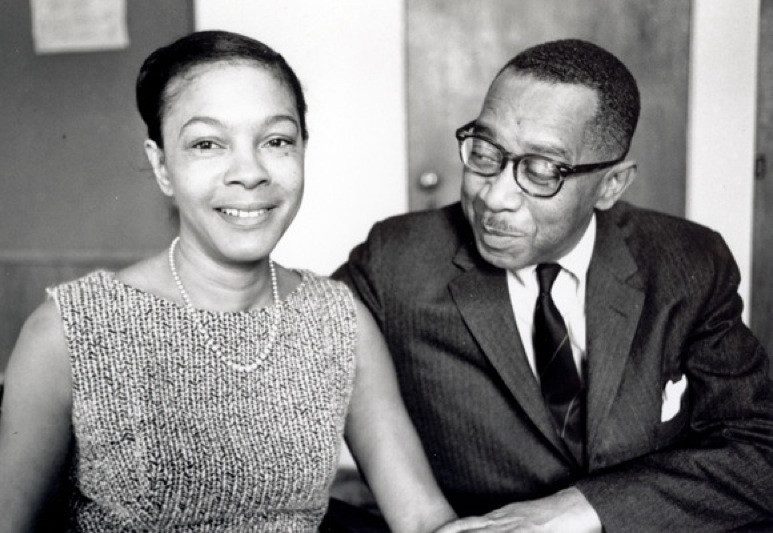
In today’s post, Ashley Everson, assistant professor of African American and Africana Studies at the University of Maryland, College Park and a managing editor of Global Black Thought, interviews Lacey P. Hunter and Hettie V. Williams about their new article, “There were no ‘Idiot Savants’ in the Group”: Mamie Phipps Clark and the Brown v. Board Decision. The article is featured in Volume 2, Issue 1 (Spring 2026), a special issue on “Black Women and the Brown Decision” (edited by Hettie V. Williams). Lacey P. Hunter is Associate Professor of Professional Practice and Associate Director of the Price Institute on Ethnicity, Culture, and the Modern Experience at Rutgers–Newark. Hettie V. Williams is Professor of History at Monmouth University.
Their article explores how Mamie Phipps Clark designed the “doll test” experiment and Mamie inspired Kenneth’s study of children. Her master’s research at Howard University and later as a doctoral student at Columbia University laid the foundation for the couple’s social psychology experiment that would factor into the Supreme Court’s decision to desegregate schools. This article examines the historical contributions of Mamie Phipps Clark as a thinker and scholar in her own right.
Ashley Everson (AE): You note that relatively few studies examine Mamie Clark’s groundbreaking research, and those that do often position her husband, Kenneth Clark, “at the forefront of the couple’s groundbreaking work in child psychology.” How does recovering Mamie Clark’s intellectual contributions to the Brown case reshape our understanding of its legacy? How does framing her work as intellectual history complicate dominant narratives about women’s roles in the school desegregation movement?
Lacey Hunter (LH): Identifying Mamie Clark’s contribution to the Brown case is vital for seeing its intricacies. Although the outcome was school desegregation, there were dozens of other implications for African Americans resisting racial oppression at the time. The Brown victory aided civil rights activists in so many other ways, and Mamie Clark’s work was critical in that process. Her tests helped to pave the way for studies on Black racial construction in children as early as four years old.
Mamie’s work also laid a foundation for studies on colorism among Black children. When we position this within the broader goals of the Brown case, we can see that she was an ideal researcher for the NAACP and the families connected to the case.
Brown v. Board opened a floodgate of possibilities for later generations to begin unpacking the socio-political and psychological impacts of segregation and anti-Black racism. I think the national dialogue about the desegregation movement tends to underscore women as mothers fighting for their children or as courageous individual actors refusing to comply with unjust laws on trains, buses, or in cafes. This sort of narrative overshadows Black women’s multitiered efforts to protect their communities and each other. Mamie Clark’s research was one dimension of that work. Her ideas affirmed the activism of community organizers nation-wide who were working to address the overt and implicit legacies of racism every day. Clark’s lifelong work with the Northside Center is one example of this. She explored child development in her research, but she also used her research to support families in Harlem for decades after the Brown case was decided.
Hettie Williams (HW): Clark’s husband clearly attributes his wife as the originator of the doll test ideas. She also dies before him and in many instances, her papers are embedded within the larger collection of his papers–something that is seen across archival records often involving famous or well known women who were the spouses of men with equally prominent reputations. Mamie’s parents financed the Northside Center where the couple worked with Black children in Harlem. Her contribution to their partnership as a couple but also as scholars is well evident.
AE: You assert that Clark’s contributions extended to feminist psychology and stood in direct opposition to the work of her openly segregationist dissertation advisor, Henry Garrett. To what extent did Clark’s research shape not only the outcome of the Brown decision but also the future trajectory of modern psychology as a discipline?
LH: Clark’s findings were continuously challenged by other scholars, but no one offered any feasible explanations as to why children across age groups had such strong preferences for lighter features. I think this was the most compelling dimension of her work and testimony. Regardless of what people chose to believe, the results of the studies she conducted were consistent. This, in conjunction with the other evidence presented to the Supreme Court was certainly a determinant in the Court’s final decision. Drawing on studies of children to better understand race, and by default racialization, was an ingenious means of testing national ideals of equality.
Clark’s research was also instrumental in opening new dimensions for psychological practice. Namely, her work paved the way for what would become an Africana/Black Studies approach to clinical psychology.
This methodology, which blends disciplines like behavioral science with social work and other fields, laid a road map for psychological studies and practice grounded in an awareness of race and ethnicity.
HW: I consider Mamie Clark to be one of the original founders of feminist psychology. Her work continues to be used by those working in the field of psychology sometimes with little or no attribution. Clark was a formidable scholar in her own right and there has yet to be a stand alone biography of Mamie Clark despite several on her husband. Her work gets obscured by the “great man” theory of history despite her expansive research that she did in the field of psychology.
AE: What can students learn from the ways Mamie Clark’s foundational role in developing the doll test has been obscured, despite a clear written record affirming her authorship? What do you hope students will take away about Black feminist intellectual history through Clark’s story?
LH: The marginalization of Mamie Clark in the larger narrative about Brown v. Board, and the children’s studies that helped the NAACP win its case, compel us to continue asking tough questions. Kenneth Clark always credited Mamie for her leadership in the children’s studies he worked on with her. Even so, their colleagues continued to credit him for the work. I think students should be encouraged to consider this refusal to acknowledge Mamie as an equal partner. In a larger sense, Mamie’s story can help students better understand how important historical actors are obscured by social norms that refuse to recognize them.
I hope students who learn about Mamie Clark’s work will come away with a sense that Black women’s intellectual labor is often carried on through embodied practice. Mamie was dedicated to exploring the full potential of her work. She spent her life working out answers to her questions. In doing so, she helped hundreds of people and built a legacy that continues to expand her early vision.
HW: The doll test has long entered the American popular imagination. It is important for Black women and girls to understand the central role played by Mamie Clark in this important moment in history.
The social science scholarship of Black women was foundational to the Brown case. This was a case that rested on the theory of sociological jurisprudence (a theory that argues that laws can be understood as a part of the larger consequences of social circumstances or conditions; or that laws have a social impact that can be demonstrated in social science data and facts).
AE: A recurring theme across this special issue is the agency of women and girls in the fight for desegregation. In your research on Clark, where do you see her most forcefully asserting her agency as a psychologist in her own right?
LH: Clark’s dedication to community and to people in need of resources is the most impressive thing about her. She worked tirelessly to steer the Northside Center in the years after the Brown case, and she created a space that provided mental wellness support alongside things such as tutoring, family counseling, and advocacy. Despite being criticized for her multitiered methods, she powered on. By the 1970s, she developed the kind of institution that is now considered innovative and progressive. She proved that mental wellness is tethered to our material conditions and she worked to develop strategies that empowered the communities around her.
HW: Clark wrote several stand alone essays and articles about child psychology cited in the essay. She was also an equal partner in the essays co-authored with her husband. She was a well educated woman with a brilliant mind who made substantive contributions not only to feminist psychology but also developmental psychology based on her contributions to the study of self-concept in communities of color.
Copyright © AAIHS. May not be reprinted without permission.