
Rhythms of Resistance in Afro-Latino Identity, Music, and Culture
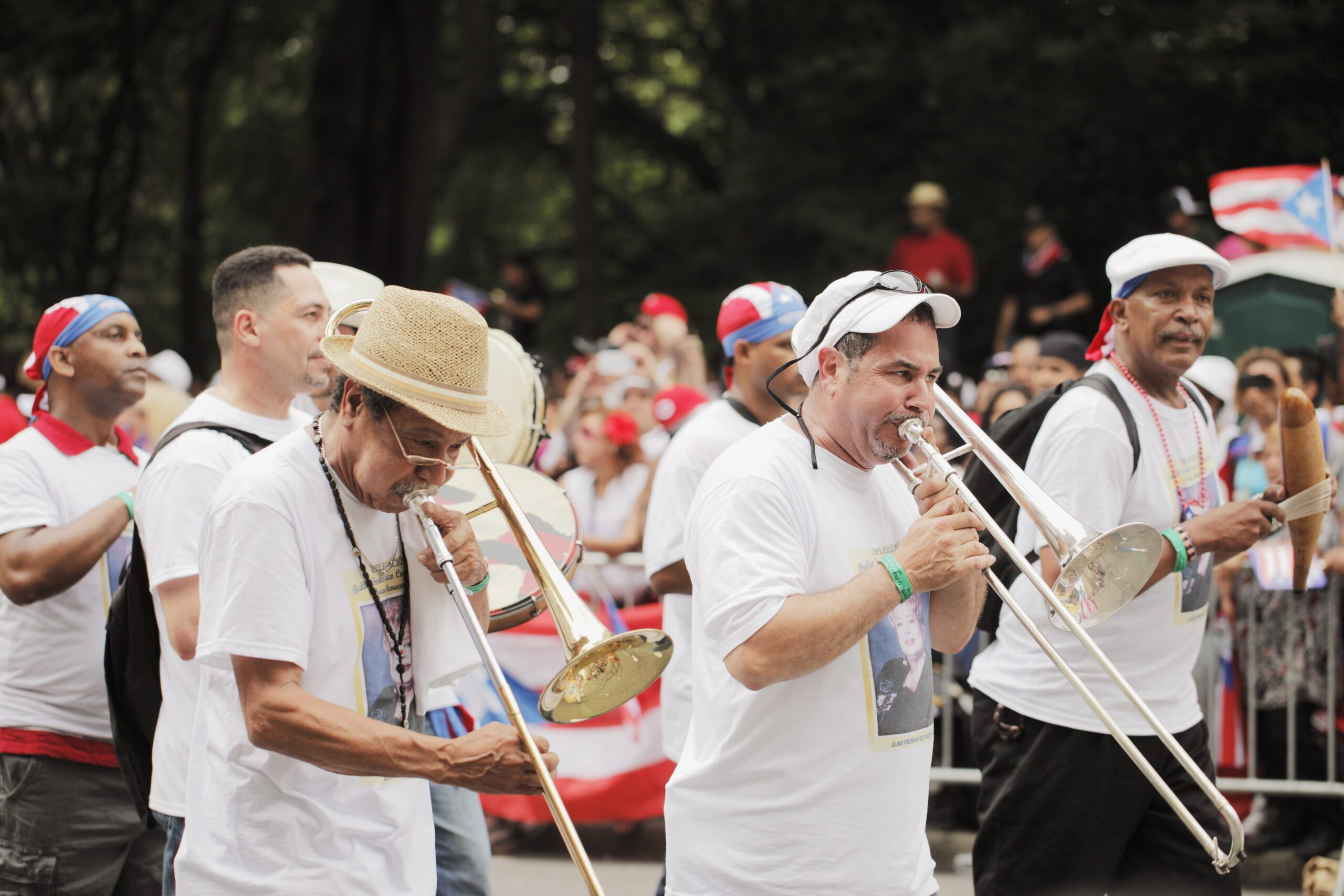
The opening beats from the bombas de pellejo at Bad Bunny’s Super Bowl Halftime show came from an instrument brought over by enslaved Africans to Puerto Rico. Bad Bunny then displays a sugar plantation, signaling to the enslaved people who helped build what Puerto Rico is today and the island’s heritage rooted in the African Diaspora. As Vanessa Díaz and Petra R. Rivera-Rideau have argued, Bad Bunny’s music “draws from the long history of Puerto Rican music-making as a form of resistance, particularly against U.S. colonialism.” This article situates Bad Bunny’s Super Bowl performance and music more broadly in the context of U.S. imperialism. I argue that his performance reflects the strength and recovery of Puerto Rican roots in traditional music and the Black Atlantic as a form of resistance to empire.
In defiance of U.S. empire, Puerto Ricans have preserved their culture through music. After the U.S. administration took over political and economic control of the island from Spain on December 10, 1898, the United States removed subsidies that supported the arts in Puerto Rico.1 In response, Puerto Ricans petitioned, organized, and fundraised to fund the arts in schools and public spaces. Arístides Chavier Arévalo, for instance, a Puerto Rican pianist and composer, advocated for the return of musical instruction to public schools in 1937 because “the cultivation of this art is absolutely indispensable for a community’s moral progress . . . Puerto Rico, a land of music, [is] . . . a country blessed with musical talent.” Preserving traditional music, as one of many forms of resistance on the island, holds a historical place in the face of U.S. empire.
Furthermore, despite U.S. news outlets such as The New York Times claiming that Puerto Rican “inhabitants are eager for annexation,” Puerto Rican activists like Arturo Schomburg wrote to The New York Times and The Times editors criticizing the U.S. for metaphorically and physically flying the U.S. flag over Puerto Rico’s public buildings. He also critiqued the U.S. for not allowing Puerto Ricans to vote and for changing the island’s name to “Porto Rico,” which remained until 1931. After a series of debates in Congress, including the Insular Cases and the Jones-Shafroth Act of 1917, Puerto Rico was granted U.S. citizenship and partial representation in Congress, but not the right to vote. While the island remains a U.S. territory today, citizenship is limited for Puerto Ricans.2
From Schomburg to Bad Bunny, many Puerto Ricans advocated for decolonizing Puerto Rico from Euro-American influence by highlighting the negative effects of imperialism.
For instance, Ricky Martin, in his performance of Bad Bunny’s song at the halftime show, Lo Que le Pasó a Hawaii, sang, “They want to take away the river and also the beach, they want my neighborhood, and that grandma leaves. No, don’t let go of the flag or forget the lelolai, that I don’t want them to do to you what happened to Hawaii.” Following the lyrics, the performance portrayed a power outage on the stage. The lyrics, coupled with the performance, highlight how the United States has mistreated its territories, whether turning them into tourist attraction sites, exploiting Indigenous people and their land for U.S. profit, or not providing the territories sufficient funds. Bad Bunny joins a long historical line of anti-imperialist movements by calling out its unjust actions and also by centering the Black Atlantic.
Bad Bunny’s music reflects transatlantic cultural exchange and the blending of different musical forms stemming from African and African diasporic traditions. For example, Bad Bunny’s DeBÍ TiRAR MáS FOToS, his most recent, Emmy-winning album, reflects elements of plena: a style of music blended with African and traditional Puerto Rican music. As mentioned earlier in Bad Bunny’s introduction to his halftime performance, plena features the instrument bombas de pellejo, which are “skin-headed drums” that usually invite people to participate in a “call-and-response” form of singing and dancing. In 1826, a government decree declared the bombas de pellejo as one of the few forms of recreation that enslaved Africans were permitted to participate in on the plantations. This allowed them to commune, honor, and identify with their cultural heritage. The instrument became widely popular throughout the Caribbean as enslaved populations brought it to various colonies, establishing and shaping Black identities in the Caribbean.
Another important element of Bad Bunny’s music is reggaetón, which exemplifies Afro-diasporic recovery and “redirects the gaze towards Africa’s diasporas.”3 Reggaetón is a style of electronic music, popularized in the late twentieth century, with elements of Latin hip-hop and Jamaican dancehall music that reflects a cultural exchange of Caribbean musical identities. It draws on “beats, vocal styles, and other aesthetics from several popular genres” in Caribbean African diasporic communities that grew exponentially in Puerto Rico and Puerto Rican groups throughout the Americas. The style of music speaks on “racial exclusion,” and “diasporic belonging,” connecting “African diaspora sites” to, as Alejandro L. Madrid explains, a “shared history of colonization, diasporic movement, and immigration” in the Spanish Caribbean.4 Petra R. Rivera-Rideau, in Remixing Reggaetón, explains that the United States and Puerto Rico have historically projected a rejection of Blackness, or a facade of “racial harmony.” Mainstream reggaetón in Puerto Rican music, and Bad Bunny’s embrace of it on national television, make his performance all the more significant. Rivera-Rideau continues to state that reggaetón reflects a “cultural practice of diaspora” that identifies Blackness as “essential to contemporary Puerto Rican life.” Reggaetón in Puerto Rican music, such as Bad Bunny’s, is claiming its ties to the Black Atlantic and production of cultural exchange in Afro-Latino identities in the Caribbean. While simultaneously “producing new ways of understanding of Puerto Rican identities,” reggaetón rejects Euro-American imperialist influence in Puerto Rican culture by centering Black Puerto Rico. Thus, Bad Bunny’s performance demonstrated this infusion of Black Puerto Rico with an anti-imperialist critique. Paul Gilroy explains how music empowers “transatlantic Black creativity” that transcends nation-state boundaries, spurring new ideas and shaping cultures. Music was fundamental in forming a unified Black identity that resisted power structures, such as empires. Gilroy’s point comes to life through Bad Bunny’s tri-racial, culturally informed music, which infuses African and African diasporic, Latin trap, and Taíno traditions. Puerto Rican cultural music survives and thrives in spite of the Spanish and U.S. empires. Blending these historically rich rhythms of resistance, instruments, and musical traditions exemplifies “transatlantic Black creativity,” which was rewarded with multiple Grammys mere months ago.
Bad Bunny’s music and performance cannot be fully understood without the context of imperialism. His music and Super Bowl performance exemplify how U.S. imperialism is present today but also how Puerto Rican roots in the Black Atlantic reflect a culture that decenters white Euro-American imperialist narratives. Despite some of the backlash to Bad Bunny’s performance, many U.S. citizens were enthusiastic about his passionate embrace of a complex Puerto Rican culture. His popularity, enhanced by his controversy, signifies the persistence of Afro-Latino identity, music, and culture.
- “The Mystery of the Sea,” The Times, Washington, Monday May 16, 1898, 4; Marisabel Brás, “The Changing of the Guard: Puerto Rico in 1898,” Library of Congress, World of 1898: International Perspectives on the Spanish-American War, https://guides.loc.gov/world-of-1898/puerto-rico-thetheoverview; and “Treaty of Paris,” Library of Congress, 1898, https://guides.loc.gov/world-of-1898/treaty-of-paris. There were also anti-imperialist debates circulating in the United States with the American Anti-imperialist League, for example, in June 1898 arguing that owning colonies was a step backward toward slavery. See: The Chicago Liberty Meeting Held at Central Music Hall: April 30, 1899 (Chicago: 1899), https://hdl.handle.net/2027/hvd.hnsf6v. ↩
- “1917: Jones-Shafroth Act,” Library of Congress, https://guides.loc.gov/latinx-civil-rights/jones-shafroth-act; Richard L. Wilson, “Insular Cases and the Supreme Court,” EBSCO, 2023, https://www.ebsco.com/research-starters/law/insular-cases-and-supreme-court#insular-cases-and-the-supreme-court. ↩
- See scholars such as José Luis González, Zenón Cruz , Petra R. Rivera-Rideau, and Isar P. Godreau who provide historical discourses on racial hierarchies and racial acceptance of Blackness as an equal contributor to the cultural identity of Puerto Rico. For example, see Frances Negrón-Muntaner and Raquel Z. Rivera, “Reggaeton Nation,” Nueva Sociedad: Democracia y Politica En America Latina no. 223 (2009), 39, quoted in Petra R. Rivera-Rideau, Remixing Reggaetón: The Cultural Politics of Race in Puerto Rico (Duke University Press, 2015), 4. ↩
- Alejandro L. Madrid and Robin D. Moore, Danzón: Circum-Caribbean Dialogues in Music and Dance (Oxford University Press, 2013), 17, quoted in Rivera-Rideau, 5. ↩
