
Honor, Fury, and Reproductive Retribution in Philadelphia

Vengeance Feminism is a bold and timely Black feminist reading of Black women’s enactments of violence in the archives of late nineteenth-century Philadelphia. Personal, political, and affective, Gross’s theorization of vengeance feminism holds together instances of Black feminist vigilantism, self-defense, and, perhaps most unexpectedly, emotional “exorcism” (11). With vivid recounting of details from her sources, Gross theorizes vengeance feminism as a form of Black feminism that reverberates into the present, taking the context of state abandonment, misogynoir, desperation, fear, and fury in the lives of Philadelphia’s late nineteenth-century Black women as a case study. Drawing upon a painstakingly-compiled archive of local news articles, docket records, city directories, annual reports, and court proceedings as well as careful citations to foundational Black feminist texts, Gross constructs a critical archival methodology characterized by close reading, detailed endnotes, and vivid narrative imagery in her reconstruction of the women’s interactions with the state, the courts, the press, and white and Black men and women. Key themes that appear throughout the book include rage, honor and virtue, respectability, revenge, patriarchy and misogynoir, justice, Black femininity, domestic violence, and lawlessness—which she uses to refer to the “misogynoir erected and sustained by biased laws and their antiblack enforcement through unequal policing, adjudication, and confinement” (11).
Chapter 5, “Their Dead: The Three Marias and the Babies in the Privy,” addresses abortion and infanticide, using the term reproductive retribution to hold space for the emotional experience of anger alongside reproductive self-determination as part of those acts of abortion and infanticide that, according to Gross, constitute a “vengeance feminist response to the inequalities that stigmatized them for having sex and for not wanting to be mothers, or for privileging themselves and their own desires” (137–38). Suggesting that the acts of women like Maria Waters, Maria Harris, Henrietta Thompson, and Mary Johnson serve as evidence of more than simply the pressures of respectability politics or the social and emotional consequences of poverty and marginalization, Gross boldly argues that there was a “different kind of political consciousness at work—one that viewed their own lives as more important than motherhood or the lives of the newborns” and fetuses and that this was a “revolutionary concept, a vengeance feminist concept,” especially in cases of infanticide because women were more likely to survive it than abortion (147). In other words, Gross assigns the concept of reproductive retribution to cases wherein “Black women’s and girls’ deadly efforts to evade motherhood [amounted to] a kind of corporeal blow against the hypocrisy that would label them as fallen” due to their participation in premarital sex or experience of rape (157).
In this socially, legally, and politically volatile contemporary moment, Gross’s theorization of reproductive retribution creates an opportunity for Black feminist scholars and practitioners to more deeply consider the relationship between extralegal instances of reproductive self-determination and reproductive justice. If there is indeed room for violence and vengeance in Black feminism, as Gross has suggested, what might this mean for contemporary understandings of reproductive justice?
Contemporary court cases criminalizing pregnant Black women based on fetal personhood claims, especially when considered alongside the fall of Roe v. Wade and the increasing prevalence of all manner of abortion bans, provide evidence that this question demands practical and timely attention from Black feminists. In her conclusion, Gross mentions the 2023 case of Brittany Watts in Ohio who was arrested in the wake of a miscarriage (165). Watts’ case is part of an extensive history of pregnancy criminalization, family policing and surveillance, obstetric violence, and fetal personhood—a logic foundational to laws that grant fertilized eggs, embryos, and/or fetuses the legal rights and status of born people, including the right to life, while stripping pregnant people of their own legal rights—that impacts pregnant people uniquely at the intersections of race, gender, class, and real or suspected substance use. As of this writing, since the Dobbs v. Jackson Women’s Health Organization decision in 2022, there have been at least 30 legal cases charging Black pregnant people with crimes related to pregnancy, pregnancy loss, and/or childbirth in the United States. This number, of course, does not capture the many Black women and pregnant people who have been subjected to obstetric surveillance, policing, and violence independent of criminal cases—those dehumanizing experiences are normalized and legitimized at least in part via the logic of fetal personhood. From a reproductive justice perspective, what might reproductive retribution, as Gross uses it in the context of the late nineteenth century, suggest about our contemporary moment, if anything at all? As cases like these coalesce in the fallout of Dobbs, hopes continue to dim that the judicial system will protect or uphold Black women’s reproductive liberty, and we are reminded of earlier times when Black women have been forced to take matters into their own hands. We might remember, too, the demand for birthing people’s full and unconditional bodily autonomy that sits at the heart of the birth justice framework, itself a reproductive justice framework, and that might offer an alternative way to think about cases in which Black women have charted a path away from the politics of respectability and defended their honor and dignity at all costs.
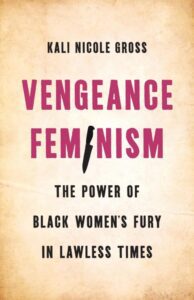 Among Gross’s feats in Vengeance Feminism is how she stretches existing threads of Black feminist renderings of history in new critical directions. She chronologically extends Nikki M. Taylor’s contributions in Brooding Over Bloody Revenge: Enslaved Women’s Lethal Resistance (2023) to reflect on the Reconstruction and post-Reconstruction periods and expands on her own reflections on Black women, crime, democracy, and representation from her earlier work, Colored Amazons: Crime, Violence, and Black Women in the City of Brotherly Love, 1880-1910 (2006). In her attention to the women’s violence as a means not only to punish wrongs that the state would not, but also to “exorcise their rage at misogynoir,” she also continues a long Black feminist tradition of regarding Black women’s emotional worlds as important sites of information and transformation (11). Ultimately, she seeks to situate “vengeance as a viable, feminist practice” and, in so doing, to theorize vengeance feminism explicitly as a “type of Black feminism . . . [that] largely served its proponents’ needs during a period when they were subjected to gross racist and gendered double standards” (7, 12). In this bold move, Gross invites scholars of history and feminism to more seriously consider strategies of revenge and violence that depart from liberal and bourgeois Black feminisms and their respectable moral codes. This contribution is significant for scholars of Black feminism and Black women’s history because it joins the chorus of work demonstrating that falling in line with respectability politics was and is not the only way that Black women have enacted our commitment to protecting ourselves and defending our honor. Gross’s work to theorize the actions of ordinary women like Ida Payton, Annie Cutler, and Mary Crawford together with expert badger thieves like Georgianna Coleman, Julia Mason, and Sarah Palmer via a Black feminist lens yields evidence that—despite the politics of respectability, democratic rhetoric, and the ethics of nonviolence that Black feminists have tended to espouse—there is indeed room for violence, bloodshed, trickery, and extralegal behavior in Black feminism.
Particularly notable is Gross’s mobilization of these women’s stories to illustrate a larger theoretical point about Black feminism and its proponents: Black women who committed vengeance feminist acts of violence and trickery took hold of and defended their own honor in unique ways, insisting upon the “sanctity of Black womanhood” in the context of affronts to their dignity and their exclusion from the category of mainstream womanhood (coded as white) that would otherwise command patriarchal “protection” (26). It follows that, as Gross contends, vengeance feminism’s commitment to the dignity and value of Black womanhood renders it “ideologically adjacent” to the early Black feminist thought of respectable, well-educated, elite race women. However, she emphasizes the particularly “expert knowledge” drawn from the depths of “violence, violation, deprivation, and corruption” among women like those badger thieves whose lived experiences led them to expertly weaponize their own debasement and commodification against their enemies and towards their own financial—and perhaps emotional—benefit (120–22). In so doing, she offers a refreshing alternative meditation upon what constitutes Black feminist knowledge/theory and where affect—particularly Black women’s individual and collective affective experiences of rage and fury and their resultant pursuits of retribution—falls in with the former.
In tracing the pervasive environment of lawlessness in historical and contemporary contexts via the stories of women like Mamie Brooks, Laura Anderson, and Carlisha Hood, Gross both reflects on and herself models both a refusal to take for granted the empty promises of American democracy and a self-reflexive critique of mainstream feminisms’ propensity to espouse the rhetorics of democracy, respectability, and nonviolence. This move is particularly critical in a contemporary political and sociocultural moment defined in large part by the rising tide of fascism as well as the continued fracturing of long-compromised structures foundational to democracy in and beyond the U.S. context. Since “Black feminism is often charged with restoration and repair,” Gross’s theorization of vengeance feminism ultimately offers Black feminism a way to loose itself from the burden of repairing the world amid the growing list of wrongs committed against marginalized peoples the world over (9).
*This essay was originally published in Vol. 2, Issue 1 (Spring 2026) of Global Black Thought. Copyright © 2026 AAIHS.
Copyright © AAIHS. May not be reprinted without permission.