
Black Women Fighting Back: Philadelphia Style
Black women’s history is filled with examples of individual women—and the organizations they helped to create—fighting back against a host of injustices. Anti-lynching crusader Ida B. Wells, feminist educator Anna Julia Cooper, and members of the National Association of Colored Women’s Clubs—the first Black civil rights organization—represent a range of ways Black women used their public writing and community engagement to fight back against racism and sexism in late nineteenth- and early twentieth-century America. Working-class and poor women in Philadelphia fought back against injustice too. These women’s backgrounds and behavior ranged from the “wanton, lascivious,” and “intemperate” to “those who had education and jobs and held to traditional social mores and middle-class aspirations” (1). These women fought back with their fury using “razors, pistols, hatchets, blackjacks, and balled-up fists” (11). Award-winning historian Kali N. Gross knows these women’s stories well. Her groundbreaking scholarship established the legitimacy of Black women and girls in Philadelphia’s criminal justice system as historical subjects. In Vengeance Feminism: The Power of Black Women’s Fury in Lawless Times (2024), she shifts the focus of that earlier work by defining these women as political actors who used their fury, often through violence, to seek revenge for the misogynoir they experienced in their communities and in the legal system. The book, Gross explains, is “about Black women lashing back, often violently and not always righteously. It’s about the extremities Black women used to escape total victimization” (1).
Vengeance feminism—the theory—stems from Gross’s longtime study and reconsideration of Black women entangled in Philadelphia’s late nineteenth- and early twentieth-century legal system. She connects Black women’s anger to the perennial lawlessness that shaped their everyday life.
The book defines lawlessness as “the misogynoir erected and sustained by biased laws and their antiblack enforcement through unequal policing, adjudication, and confinement” (11). Rape laws in Pennsylvania, for instance, failed to punish men—of any race—for sexually assaulting Black women while the penalties for raping white women meant that a Black man would face a death sentence and “a white man would be publicly whipped and subject to seven years of indentured service” (58). Racially-biased laws and sentencing impacted the entire Black community. Working-class and poor Black women used their knowledge of the unjust legal system alongside violence to defend themselves against dishonor and disrespect as they sought retribution. Gross, as a result, does not simply use a Black feminist lens to analyze their self-defense strategies and the fury that fueled it but rather identifies and explores the feminist politics of her historical subjects.
Vengeance feminism is complicated. The theory builds on and diverges from traditional Black feminism. Both emphasize women’s equality, the fight against misogynoir, and a focus on the “veneration of Black womanhood and bodily sanctity” (9-10). They both understand anger as an important tool when fighting for justice. Yet vengeance feminism departs from traditional Black feminism’s focus on nonviolent protest, collective action, and an emphasis on “restoration and repair” (8-9). This alternative form of Black feminism was “violent and extralegal,” its attendants did not defend themselves in the “right way,” and they did not always succeed when fighting back against injustice (12, 2). Gross emphasizes, in compelling prose, that—however fleeting their victories—vengeance feminists’ “existence proves that Black women were not always long-suffering hostages, buffeted around helplessly by the savagery of the system” (2).
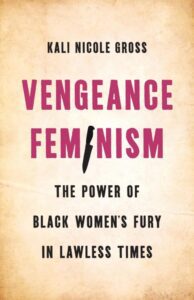 Vengeance Feminism is Gross’s fourth monograph, and it shows. Her deep engagement with multiple historiographies and her impressive work in the archives exemplify the skill, rigor, and care of a senior scholar who has thought about her historical subjects with depth. Her focus on Black women’s combination of anger with violent tactics to address lawlessness makes several important scholarly interventions in studies of criminal justice, Black feminism, and Black women’s history. She joins Black feminist scholars—like Nikki Taylor, Brittney Cooper, and Kellie Carter-Jackson—whose work has emphasized the connections between Black women’s anger, resistance, and justice. Focusing on the inner lives of Black women that did not leave behind traditional sources, Gross accesses their rage through Philadelphia’s extant, and often incomplete, criminal justice records. Her training as a historian and her expertise with archival sources shapes her use of informed speculation regarding what these women’s responses to lawlessness and dishonor meant. Twenty-four-year-old Ida Payton’s case provides an example of vengeance feminism at work. In 1893, Ida and Samuel Jackson became embroiled in a vicious altercation. Both assaulted one another with brutal blows: he slapped her in the face, and she hit him with a blackjack (27-28). Yet when Jackson called Ida an “ill name,” apparently an insult so malicious that no witness repeated it in court, she believed he crossed the line and ended his life with a fatal gunshot (29-31). Payton may have been angry when she attempted to protect her body from his attack, but Jackson’s verbal slur prompted her to defend her sense of personal honor with fury and violence when no one else would.
Drawing on court and prison records, annual police reports, newspaper articles, census records, and city directories, Gross uncovers an incredibly complex archive of Black life. As wives, lovers, mothers, friends, laborers, business owners, and church members, Black women’s lives—their pain, desperation, disappointment, and joy—are chronicled with careful analysis. Philadelphia and its inhabitants come alive through Gross’s true crime writing style that is provocative and fascinating. Vengeance feminism stems from the stories of women like Ida Payton, Annie Cutler, and Mary Wright who obtained justice on their own terms in a society that often failed to acknowledge or protect them. Their cases illustrate how respectability—whether these women embraced its tenets or not—and urban pleasure shaped how they negotiated the City of Brotherly Love.
Annie Cutler’s case conveys how a woman’s despair and fury over the promise of a marriage proposal resulted in murder. In 1885, Annie discovered that her boyfriend William Knight married someone else and failed to inform her. Knight had persuaded Annie to migrate from New England to Philadelphia where she worked with him and thought she was building a life—including giving him her money and her virginity—before she became his wife. After discovering his lies and his refusal to return her money or apologize, her “grief and shame” transitioned to “rage” (32). Her fury at the situation prompted her to fatally shoot Knight without remorse: “I could kill him twice for the wrong he has done to me” (34). Through the lens of vengeance feminism, this case was more than a jilted lover’s violent response but a stark example of how Annie sought to avenge her respectability and honor. Gross contends that learning about Annie, and women like her, reinforces the “unexpected space, dialogue, and outcomes created when Black women act on fury in the name of vengeance” (2).
Philadelphia’s Black elites’ support of Annie’s vengeance feminism represents a major unexpected response to her case. Intraracial class conflict over moral respectability is a consistent theme in Black women’s history. There are countless examples of Black leaders who believed that working-class and poor women needed to adhere to a politics of respectability: to protect the individual from vice and as a strategy of racial advancement that would help dispel white supremacist stereotypes about alleged Black immorality, inferiority, and criminality. For instance, when some Black women appeared not to meet W.E.B. DuBois’s rigorous moral expectations during the research for The Philadelphia Negro (1899) his response was harsh, skeptical, and unrelenting: “A large number of widows are simply unmarried mothers and thus represent the unchastity of a larger number of women” (141). Yet members of Philadelphia’s Citizens’ Suffrage Association reacted with public empathy for Annie and moral outrage at the actions of her murdered lover. Prominent Black Philadelphia leader Robert Purvis told the press, “I think she is a hero in a true sense of the word and has rid the world of a villain” (42). He and others did not blame Annie for having premarital sex that she believed would lead to marriage. Instead, they sought to highlight those cases of unsavory men who duped young women by exploiting their desire for companionship and eventual marriage. Mrs. Emma A. Rhoads, another Association member, suggested that Annie’s issue was a larger social problem. She argued that more women should avenge their honor and respectability through violence like Annie: “I think I would be glad . . . if more of our women so treated would do the same thing” (41). Black leaders’ sympathetic responses to Annie’s behavior reveal important ways to expand our understanding of intraracial class dynamics around moral respectability.
Mary Wright’s case of a church girl who liked to have secular fun offers a window into how Black women and girls experienced urban pleasure. Innovatively using criminal justice records, Gross reminds readers that single and married women sought local amusements and sensual adventures when not laboring. Her vivid storytelling takes the reader through the city with women who drank in saloons, danced the night away with multiple partners, attended “colored” picnics in the park, and simply spent time enjoying the company of friends and acquaintances. Sometimes this pursuit of leisure resulted in friction with other residents, lovers, husbands, friends, and employers. Live-in domestic Mary Wright, for instance, received no complaints about her work performance but her employer raised questions about her social life after Mary “managed to sneak off and frolic with friends” and returned home late at night (87). Her employer also surveilled Mary enjoying visits from several romantic suitors on the front stoop (89). Indeed, Black women were desired and acted on their desires. They dated, were courted, and some women consented to sex because they wanted pleasure rather than believing intercourse was a precursor to marriage. Even as they pursued Black joy, they understood that urban pleasure could easily shift to danger. Records often reveal how Black women defended themselves and their honor with knives, blackjacks, and their fists.
Vengeance Feminism offers a bold history of how Black women fought back against racial injustice and misogynoir in late nineteenth- and early twentieth-century America. The book not only offers a way to understand Black women’s anger but, most importantly, shows how the implementation of their fury and essential knowledge of the legal system constituted a legitimate Black feminist practice.
Using sources created to reinforce Black women’s criminality, Gross reads against the grain and finds working-class and poor Black women’s voices, community, and feminism. Confident in her work’s strength, Gross also highlights its limitations. Every act of feminine violence was not activism. She admits that in some instances the work can be “unwieldy and uneven” because vengeance feminism “resists clean lines and linear thinking” (16). She is also honest about the fact that while she is fascinated with these women’s lives—she adores unruly Black women—she continues to “wrestle with the full import of vengeance feminism” (16). We learn about Black feminism through a different lens, which provides us with a window into these women’s pursuit of joy and those instances when Black leaders supported them. Gross’s book captures the stories and activism of this small group of fascinating women who fought back with the tools and strategies available to them and on their own terms.
*This essay was originally published in Vol. 2, Issue 1 (Spring 2026) of Global Black Thought. Copyright © 2026 AAIHS.
Copyright © AAIHS. May not be reprinted without permission.
Your scholarly work on women and on this unknown lady is greatly appreciated.
Independent scholar,