
Pauli Murray, the Brown Decision, and the Struggle for Equal Rights
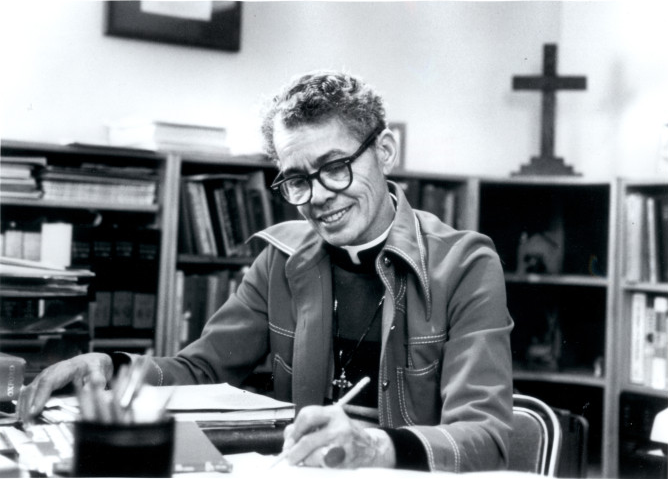
In today’s post, Ashley Everson, assistant professor of African American and Africana Studies at the University of Maryland, College Park and a managing editor of Global Black Thought, interviews Tejai Beulah Howard about her new article, “Pauli Murray’s Prophetic Imagination: Brown v. Board, and the Struggle for Equal Rights in the United States.” The article is featured in Volume 2, Issue 1 (Spring 2026), a special issue on “Black Women and the Brown Decision” (edited by Hettie V. Williams, Professor of History at Monmouth University). The article examines the life and work of writer and nonviolent labor organizer Pauli Murray (1910-1985), who, as a law student at Howard University, developed the novel strategy that Thurgood Marshall and NAACP lawyers would use to overturn Plessy v. Ferguson (1896) in the landmark civil rights case, Brown v. Board of Education in 1954.
Dr. Beulah Howard is a historian specializing in religion and the Civil Rights-Black Power era, Women and Gender studies, spiritual biography, and African American music. Her recent publications include contributions in A Seat at the Table: Black Women Public Intellectuals in US History and Culture edited by Hettie Williams and Melissa Ziobro and We Cry Justice: Reading the Bible with the Poor Peoples Campaign edited by Liz Theoharis. Having previously taught Black Church Studies at Methodist Theological School in Ohio, Dr. Beulah Howard is now an instructor of African American history at Columbus State Community College.
Ashley Everson (AE): You note that Rev. Dr. Pauli Murray’s legal theory was central to Brown v. Board of Education. What distinguishes Murray’s revolutionary legal scholarship from that of other leading civil rights legal thinkers, such as Charles Hamilton Houston and Thurgood Marshall?
Pauli Murray’s initial conversation about how to defeat Plessy v. Ferguson took place in her Howard law school classroom in 1944– with her classmates and her professor, Spottswood Robinson. In this conversation, the class was discussing how to effectively bring an end to Jim Crow. For nearly half a century, NAACP lawyers—including Charles Hamilton Houston and Thurgood Marshall—had worked to dismantle the law by questioning “the equal” part of “separate but equal.” In other words, their efforts forced them to argue that a Black school was not equal to a white one. This argument, of course, led to some victories but not a complete overturning of Plessy.
For Murray, the solution could be found in arguing that the “separate” part of the doctrine was unconstitutional and she spelled out this strategy in a seminar paper, even though her classmates (who were all male) and Professor Robinson rejected her ideas.
When Robinson joined the NAACP team led by Thurgood Marshall on the Brown case, he took Murray’s paper with him and presented it to the team. They tried this strategy and it worked! So, I would say that what distinguishes Murray from Houston and Marshall is her gender. Had she been a man, perhaps her ideas as a law student would have been taken more seriously at the time that she presented them. She was obviously as intelligent as her male counterparts, and perhaps, a bit more creative in her approach to solving the problem of legal segregation. But her ideas were initially dismissed.
AE: Throughout the article, you draw extensively from Murray’s autobiography, Song in a Weary Throat: Memoir of an American Pilgrimage. Why is it significant that Murray was able to narrate her own life and intellectual contributions? How do you use this self-authorship to illuminate her legacy within the history of school desegregation?
I think it was important for Murray to write two autobiographies because writing about her life as she understood it gave her a chance to make sense of herself and her life experiences. She was an orphan–she was a toddler when her mother died. She was sent to live with her maternal family, and she missed out on a relationship with her father, who was unable to raise her and her siblings due to his profound grief and struggles with mental health. Her earliest memory of her father was at his funeral when she was a young girl. So, on a personal level, I think autobiography helped her to make sense of her unique life story.
On a professional level, I think Murray documented her life of activism and included details, such as her contribution to the Brown case, because she was intelligent enough to realize that if she didn’t tell her story, no one else would. She didn’t find out that Spottswood Robinson had used her paper in the Brown case until nearly a decade after 1954. He didn’t reach out to tell her that he used her paper–she found out by chance during a visit that she initiated with him.
Murray’s autobiography, like so many other Black women’s autobiographies, makes it impossible for them to be overlooked and ignored for their unique experiences and their specific contributions to American culture and history.
Murray’s autobiography, Song in a Weary Throat, offers the first account of her contribution to Brown, and that’s one of the reasons why I wanted to use it for this essay. Autobiographies and biographies have been incredibly important to understanding Murray’s legacy within the history of school desegregation, and the stories of everyday activists. For example, the University of Kansas 2018 publication, “Recovering Untold Stories: An Enduring Legacy of Brown v. Board Decision,” relies heavily upon autobiographical narratives to talk about school desegregation in Virginia. From this publication and Bob Smith’s 1996 work, They Closed Their Schools: Prince Edward Country, Virginia, 1951-1964, we learn about the students, especially Barbara Johns, who was instrumental in leading student protests in Virginia. Johns’ case against the school board was also included in Brown v. Board. She is just now starting to garner national attention for her labor in helping to desegregate schools. Ultimately, the autobiographies and biographies help students and scholars of desegregation understand that Brown came about because of a decades-long struggle informed by many students, parents, activists, and lawyers from around the country.
AE: Murray’s intersecting identities as a Black, working-class, queer woman confronting racism, sexism, homophobia, and classism profoundly shaped her activism as both a lawyer and an Episcopalian religious leader. How did her upbringing within her multiracial maternal family inform her understanding of American democracy?
This question makes me think of Murray’s epitaph for her poetry collection, Dark Testament. She writes, “I speak for my race and my people—the human race and just people.” This was Murray’s vision of democracy, and I think growing up in a household with her maternal grandmother, who was the daughter of a slaveholder and enslaved woman, allowed Pauli to quickly grasp the idea that the social and political barriers between human beings were feeble, unnecessary constructions.
Her maternal grandfather’s status as a free Black man and civil war veteran helped to shape Pauli’s own fights for freedom, justice, and equality. I think her mixed-race background allowed her to develop a vision of this country that was inclusive, fair, and just for all citizens. Certainly, if her family could model a system in which people of every class and hue could come together for family reunions, then she could envision her country following suit.
AE: You argue that Murray “laid the foundation for…Womanist Theology and Ethics, which is attentive to the suffering, organizing, and wisdom of all classes of Black and Brown women.” How might we situate Murray’s intellectual and political contributions within the broader Black feminist tradition?
I think we should situate Murray’s intellectual and political contributions within the broader Black feminist tradition as a critical foremother, or one of the rocks on which the 20th-century Black feminist tradition stands. Her experiences with sexism at Howard Law School in the late 1940s shaped her into a feminist. She was a cofounder of the National Organization of Women. She coined the term, “Jane Crow,” to specifically name gender discrimination. She helped to strike down all white, all male juries in White v. Cook (1966). Her office as the first Black woman priest in the Episcopal Church made her an exceptional role model for young Black women preachers and pastors in that denomination and others. She was a tireless champion for people, Black and white, male and female. And she profoundly shaped antiracist and feminist movements in the United States.
Copyright © AAIHS. May not be reprinted without permission.