
Afterlives of the Plantation: An Interview with Jarvis C. McInnis
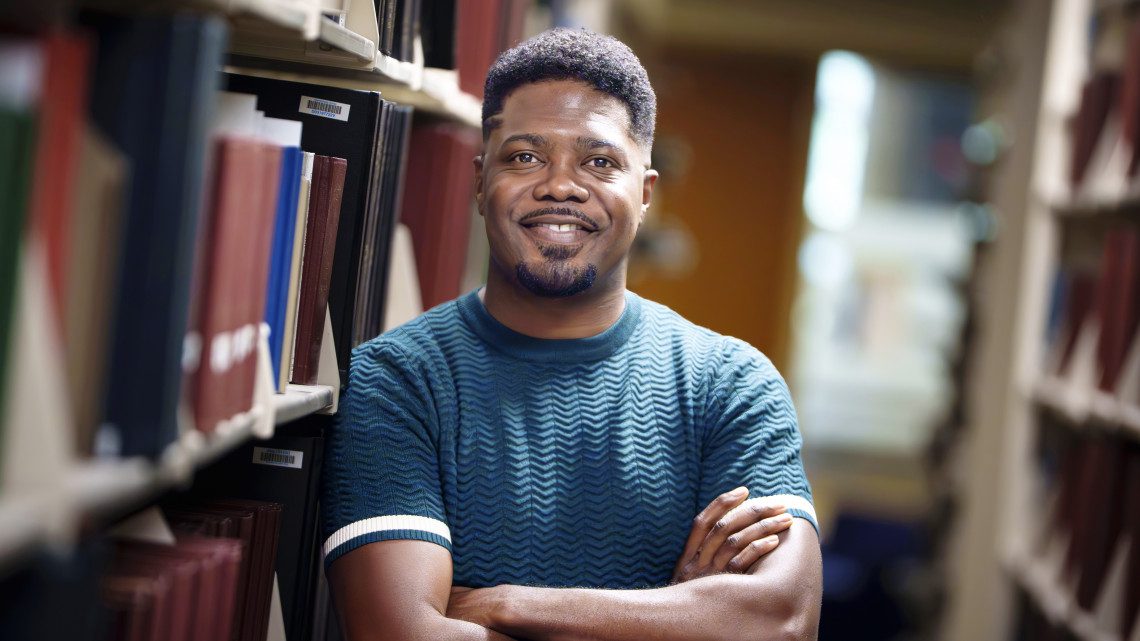
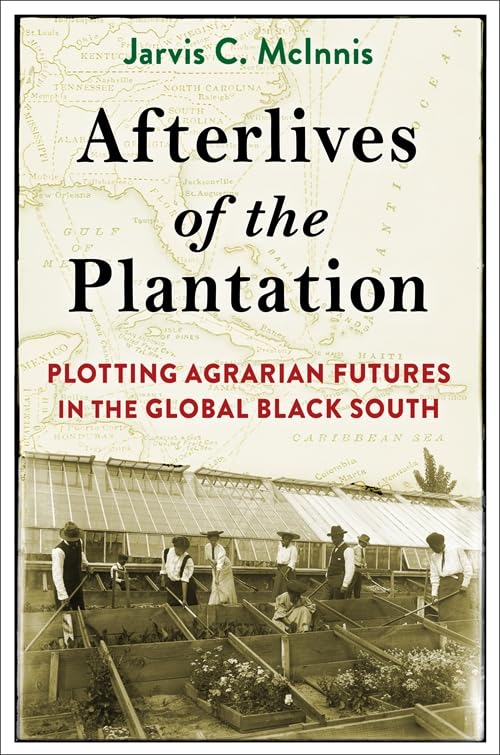
In today’s post, Dr. Robert Greene II, Former AAIHS President and Associate Professor of History at Claflin University, interviews Dr. Jarvis C. McInnis about his book, Afterlives of the Plantation: Plotting Agrarian Futures in the Global Black South (Columbia University Press, 2025). Dr. McInnis is an Associate Professor of English at Duke University, and is an interdisciplinary scholar who studies the African American and African Diasporic experiences. Dr. McInnis has been published at Callaloo, Mississippi Quarterly, Public Books, MELUS, and The Global South. Afterlives of the Plantation is a finalist for the 2026 Pauli Murray Book Prize, which recognizes the best book on Black intellectual history.
Please join us on Friday, January 30th at 12 Noon Eastern for a virtual conversation with Prof. McInnis about his new book. Click here to register.
Robert Greene II: What inspired you to write this book?
Jarvis C. McInnis: Afterlives of the Plantation is my first book, and like many first monographs, it is animated, at least in part, by personal, autobiographical concerns. I am a native southerner, born and raised in Gulfport, Mississippi. I pursued my undergraduate studies at Tougaloo College, an historically black college in Tougaloo, Mississippi, and then migrated to New York City for graduate school. While there, I learned about the richness of the cultural, intellectual, and political contributions of black people from the US South and the Caribbean who had made the Great Migration to places like Harlem, Philadelphia, and Chicago and transformed those cities into crucibles of black modern life and diasporic relation. And while I appreciated, and was even enamored of, the new possibilities Black people had access to “up North,” as a native southerner, I eventually became curious about those black folk who, like my grandparents and many members of my family, had remained in the South or who migrated North and eventually returned South.
Furthermore, as a Mississippian living in New York City, I experienced a profound anti-southern bias both interpersonally and within much of the scholarship I was engaging, wherein the US South, and especially Mississippi, were almost exclusively figured as scapegoats for the anti-blackness that’s, in fact, endemic to US (and Western!) identity and culture writ large. While I would be the last to ever downplay the abhorrent anti-black violence of Mississippi’s or the US South’s history—and am deeply committed to holding them accountable for their crimes against humanity and black people, in particular—I also recognized that there is a fund of a cultural, intellectual, and political capital among Black southerners that’s often overlooked or denied. So, I set about trying to reconcile the tension between race and region, to grapple with the paradox of being both black and southern, and to try to understand where black southerners fit within a discourse on modernity that constantly positions them as anything but modern and as the antithesis of everything associated with it: intellectual, sophisticated, innovative, cosmopolitan, and, ultimately, worthy of (Black) study.
Greene: Your book explains how a “Global Black South” changes how we consider and think about the relationship between Black Southerners and the rest of the Global South. What, in your research and writing, led you to craft this idea?
McInnis: In graduate school, I enrolled in Professor Farah Jasmine Griffin’s seminar, “The Black South,” which explored the hemispheric turn in American Studies. It was there that I first encountered Zora Neale Hurston’s southern African American and Caribbean ethnographies, Mules and Men (1935) and Tell My Horse (1938), respectively, which utterly transformed how I understood the US South’s modernity and place within black transnational and diaspora studies. So much of the scholarship I’d encountered up till then focused on either the urban, global North, or other global southern locales in the Caribbean, Latin America, and Africa. The US South and southern African Americans rarely figured as sites or agents of Black transnational movement or diasporic connectivity. Rather, they were regarded as backward, provincial, and fundamentally anti-modern. Hurston’s geographic imagination, wherein she documented diasporic ties between the US South and the Caribbean through African cultural retentions and Black labor migration to Florida, fomented the re-orientation and re-education I didn’t know I needed.
Given Black people’s immobility during slavery and restricted mobility under Jim Crow segregation, it is understandable that mobility and cosmopolitanism have become hallmarks of modern subjectivity within Black Studies. However, this emphasis on movement has tended to position Black people who did not or could not migrate, and especially Black southerners, outside of modernity.
Despite her unfortunate trafficking in the scripts of primitivism, Hurston’s southern African American interlocutors, whether mobile or rooted, were anything but anti-modern. So, I became curious about how other Black southerners in this period understood themselves as modern subjects, how they articulated their relationship to the broader diaspora, and how people from other parts of the diaspora, especially the Caribbean and Latin America, understood the cultural and intellectual contributions of southern African Americans, in turn.
These considerations led me to question some of the basic tenets of Black modernity. If transnational mobility, diasporic consciousness, and urbanity were telltale signifiers of the modern, then what about Black people who chose not to migrate and to stay put? What about those who resided in rural, agricultural regions? Does urbanity really equate to intellectual sophistication or a necessarily cosmopolitan outlook? Does rootedness really preclude one from cultivating a global imagination or diasporic consciousness? What about those instances, such as those Hurston documented, when the US South was a destination for Black diasporans, instead of simply a point of departure?
Especially integral to my conceptualization of the Global Black South was the invaluable work of Caribbean writers and scholars who’d theorized the plantation as a crucible of modernity, and scholarship in New Southern Studies exploring the plantation as a global institution that connected the U.S. South to the broader global South. This, it seemed to me, was a different starting point for understanding where and how the US South, and southern African Americans in particular, fit within modernity. Like the Caribbean, Latin American, and many other global southern locales, the region we now call the US South was forged in the crucible of modernity, through settler colonialism, transatlantic slavery, and the plantation system. Therefore, Black modernity did not commence with emancipation or even migration to the urban, global North in the early twentieth century, but rather with Black people’s conscription into the modern project, to cite David Scott. Furthermore, I realized that both historically and in the present-day, Black southerners have experienced similar conditions and practices of underdevelopment, racialization, and exploitation as peoples in other regions of the Global South. So, I wondered what might emerge if I were to think through these similarities and connections in a more sustained way.
With this new outlook in tow, I began to view black southern identity with new eyes—as always already modern, in fact—and eventually arrived at my conception of the afterlives of the plantation in the Global Black South as a paradigm that expands both the temporality and geography of black modernity and black transnational and diasporic studies.
Greene: In both the Introduction and chapter 1, you write extensively about your desire to change Tuskegee’s place in the historical narrative. The college comes alive in the book as a center of the Global Black South, a cosmopolitan and progressive institution in the broader Black world. Why was this an important component of your writing Afterlives of the Plantation?
McInnis: Full disclosure, I did not want to write about Tuskegee and much less Booker T. Washington—not to this extent anyway. Like many of us in Black Studies, I had come to understand Washington as a political accommodationist who acquiesced to social segregation in exchange for the hope of economic opportunity, and Tuskegee Institute (not the current university) as little more than a manual labor training school. Similarly, I didn’t want to write about rurality or agriculture either. Those were the stereotypes of the South that I was trying to write against in some ways, or at least circumvent, by focusing on the transnational. But I soon realized that agriculture—and the plantation, in particular—was key to the South’s globality and that Tuskegee and Washington were integral to rethinking Black modernity and transnationalism from a hemispheric perspective. In effect, this book was an exercise is submitting to the archive and the story that wanted (needed?) to be told over and over again, even when I wanted that story to be different.
As I searched for examples of connections between the US South and the Caribbean to consider alongside Hurston’s oeuvre, I encountered Frank Guridy’s important work on the Tuskegee-Cuba connection in Forging Diaspora. I already knew about Washington’s influence on Marcus Garvey, and so I thought I’d write a comparative, Washington-Garvey chapter that also touched on Tuskegee’s connections to Cuba and Puerto Rico and then leave Washington and Tuskegee far behind. But as I delved into Tuskegee’s archive, I soon realized there was a wealth of information about the institution that I and the broader field of Black Studies were either unaware of or had not fully considered. The more I attempted to run away from Washington, Tuskegee, and agriculture, the more I discovered about their importance for Black modernity and visions of Black diasporic self-determination in the late nineteenth to early twentieth centuries.
Firstly, I noticed that Tuskegee seemed to show up everywhere during the period of Washington’s rise to race leadership (1895-1915) and immediately afterwards: not only in Cuba and Puerto Rico, but also in Haiti, Jamaica, Guyana, and South Africa, among other diasporic locales. Secondly, I noticed a vast aesthetic project at work at Tuskegee through the photographs and diagrams in Washington’s writings and Tuskegee’s print culture, as well as correspondence about the school’s music program in Washington’s papers. And of course, Washington himself was an internationally renowned orator and stage performer of sorts. This led me to consider the school’s music, visual, and performance culture as an important aspect of its contributions to modern Black aesthetics that has largely been overlooked. And finally, I discovered that as much as I was trying to circumvent agriculture, Tuskegee’s primary contribution to Black modernity in this period was in fact its agricultural curriculum, especially the work of George Washington Carver. The agrarian future being articulated there was rooted in science and sustainable techniques for cultivating the land, and that’s precisely why so many diasporans were seeking out their methods.
In short, as I spent more time in Tuskegee’s archive and questioned my own biases, it became clear to me that Tuskegee was not a backward institution, as is often argued in Black Studies scholarship, but rather a site of agricultural, aesthetic, and intellectual innovation and experimentation that devised a strategy to sustain and propagate Black life in the US South and the broader Black diaspora.
Was it conservative and short-sighted in some ways? Absolutely. But the fact that so many people from across the diaspora viewed it as a model of self-determination and attempted to replicate it means there was something significant about it that we’d missed. A part of the bias against Tuskegee, I came to realize, was not only due to scholars’ disagreement with Washington’s political shortcomings—which were numerous—but also their discomfort with the centrality of agricultural and industrial education and labor within its vision of black freedom, which is not disconnected from its southernness. In other words, bound up with the critiques of Washington (many of which I share, I might add) was an anti-rural, anti-agricultural, anti-southern, and ultimately class bias as well.
 Greene: Could you talk a bit about the symbolism of Booker T. Washington? While many of our readers likely know about Washington’s importance to Marcus Garvey, in your book his stature in the eyes of Haitians, Cubans, Jamaicans, and Puerto Ricans becomes equally important. How does this symbolic embrace of Washington in the early 20th century stack up, in your opinion, against his complicated legacy in the 21st century?
McInnis: Booker T. Washington is a challenging figure to write about, in part, because he has long fallen out of favor in most corners of Black Studies. Needless to say, then, I had no desire or intention to write about him at such great lengths. Even after being immersed in Washington’s and Tuskegee’s archives for so many years, he remains a somewhat enigmatic figure and notoriously difficult to pin down. He means different things to different people, and his legacy has shifted over time. For some, he’s a race leader who worked against insurmountable odds during the nadir of African American history to create a workable strategy for black advancement. For others, he’s an elitist and conservative political boss who ruled over black politics with an iron fist, condescended to the black masses, and held a veil over their eyes as he hobnobbed and benefited from his ties to presidents, royalty, and the industrial titans of his day. And still to others, he was a trickster figure who presented one face to white elites while using his power and influence to support covert civil rights campaigns for black freedom.
Over the course of my research, it became clear that Washington exhibited behaviors that could lead to any and all of these interpretations. Yet, it’s his reputation for being a political accommodationist and hegemonic race leader that has become the predominant portrait of him in Black Studies, and Tuskegee has shared a similar fate. However, for many black folks during his day, both at home and abroad, Washington and Tuskegee represented Black self-help, race pride, and self-determination. This incongruency deeply intrigued and challenged me. And so, I set about trying to understand and ultimately restore this forgotten aspect of Tuskegee’s—and thus Washington’s—legacy to the historical record, because it teaches us about the importance of southern African Americans’ cultural, intellectual, and political contributions to the Black world and it teaches us something valuable about how Black people throughout the hemisphere envisioned freedom and progress in this period in ways that might seem foreign or counterintuitive to our 21st century values and sensibilities. Many Black people in this period were, in fact, not trying to flee farming, precisely because agriculture was still regarded as a viable pathway forward. And many of them did not hold an exclusive view of Washington as a political accommodationist or Tuskegee as a manual labor training school; rather, they were symbols of what Black people could do for themselves.
In terms of how the early 20th century symbolism of Washington outside of the US stacks up against our 21st century memory of him, I think they’re both accurate. There is no singular Booker T. Washington. He was at once a hegemonic political powerbroker who accommodated social segregation, an embattled race leader working against insurmountable odds, a trickster figure who worked to advance black people’s civil rights behind the scenes, a racial and class paternalist who condescended to the Black masses, and a school principal who cared about black students and their education. He was deeply committed to the progress and future of the race, globally conceived, and yet he was also flawed and made significant miscalculations about the nature of white supremacy and Black people’s capacity to be self-determining. My goal, then, has been to read Washington and Tuskegee both critically and generously, in order to restore some balance to the way we remember them and, by extension, the cultural, intellectual, and political contributions of a historically black educational institution in the heart of the Jim Crow South. In doing so, I attempt to broaden our scope to include not only Washington, but the dynamism of his institution, its faculty, and students, and what they enabled for visions and strategies of black self-determination throughout the diaspora. For instance, Rafael Serra y Montalvo viewed Tuskegee as a model for attaining interracial philanthropic cooperation for Afro-Cuban education, and Jean Price-Mars determined that since Haiti was a primarily agricultural country, the Tuskegee model could be adapted to establish agricultural schools for the Haitian peasantry. So even as we must remain critical of Washington’s shortcomings, it’s crucial that we not lose sight of the fact that what he symbolized and made possible often exceeded the limits of his political imagination.
Greene: Women occupy a major role in the creation of the Tuskegee New Negro model of modernity in the early 20th century. Why was it important for you to center ideas of womanhood in your book about the intellectual project of agricultural and industrial education?
McInnis: First and foremost, acknowledging the importance of Black women and girls to this story was a matter of personal politics and ethics, because Black women and Black feminism have been integral to my intellectual formation. Secondly, Black feminists have been some of the most stringent critics of the “race man” figure that Booker T. Washington represents. So, it was important to me to take their critiques seriously in my reassessment of Washington’s and Tuskegee’s legacies to avoid replicating the age-old problem of foregrounding “great men” to the exclusion of women’s contributions. Black women and girls were constitutive to the various cultural and intellectual projects I examine in the book, even if they weren’t always named in the archive. And in the case of Tuskegee, Washington’s three wives played a critical role in the school’s founding, leadership, and curricular development.
Early in my research, I came across Margaret Murray Washington’s 1895 speech, “New Negro Womanhood,” delivered a few months before Booker T.’s now-infamous “Atlanta Exposition Address,” and I wondered 1) why I’d never encountered it before and 2) why we don’t talk more about her contributions to racial uplift alongside that of her husband’s. Margaret Murray, Booker T.’s third wife, was a prominent club woman, who led Tuskegee’s Women’s department, served two terms as president of the National Association of Colored Women, and helped found the International Council of Women of the Darker Races of the World. So, it was through her that I began thinking more critically about the school’s conception of New Negro womanhood. Furthermore, Tuskegee has always been a co-educational institution, deeming education for Black girls and women as an integral part of the project of racial uplift from its very inception. Many of the school’s publications from this period delineate its unique curricular offerings for girls and women and embedded within that, I realized, was a distinct philosophy on where Black girls and women fit within the school’s conception of New Negro identity. And so, I became curious about the futures Tuskegeeans imagined for Black girls and women navigating the plantation’s afterlives, on one hand, but also how we might think of Tuskegee’s black female faculty, students, and alumnae as intellectuals and plotters of agrarian futures in their own right.
This latter and more expansive approach led me to consider the contributions of someone like Clara Shepard, who not only taught French in Tuskegee’s high school, but was also one of the principal translators of La revue du monde noire, the bilingual journal and ur-text of the Négritude Movement. In its pages, Shepard proposed the foreign language classroom as a space for forging a diasporic imagination wherein Tuskegee’s students, many of whom were the sons and daughters of sharecroppers and tenant farmers, could learn from the successful organizing strategies of Black agricultural workers in Francophone West Africa.
Finally, beyond Tuskegee and as I’ve described above, my conception of the Global Black South began with the work of a Black woman. It was my introduction to Zora Neale Hurston’s southern African American and Caribbean ethnographies that sparked my initial curiosity about what it could mean to reconsider black modernity, transnationalism, and diasporic relations from a hemispheric, south-south perspective. As I argue in the book, Hurston was a Tuskegee student once removed (educated at an industrial school founded by Tuskegee graduates) and represented a different vision of southern New Negro womanhood than the one outlined by Margaret Murray Washington in Tuskegee’s print culture. So, through Hurston, I was able to capture not only another architect of Black hemispheric relations, but also the dynamic, shifting, and sometimes conflicting ways in which Black womanhood was imagined and worked out throughout the Global Black South.
Greene: You are a graduate of Tougaloo College. Your book is a tour-de-force of scholarship about another prominent HBCU, Tuskegee University. Why was it important for you, an HBCU graduate, to write a book that centered HBCUs in the broader intellectual and cultural life of Black Americans and the broader African diaspora?
McInnis: This is such a great question. I’ll answer it in two parts. I foregrounded Tuskegee, first and foremost, because I’m a literary scholar, and Tuskegee has had a significant impact on the black literary tradition: from the publication of Booker T. Washington’s slave narrative, Up from Slavery, to fictional depictions of the school in works like Nella Larson’s Quicksand (1927) and Ralph Ellison’s Invisible Man (1952). In this way, the school’s vast literary footprint gave me a way to tackle the key questions animating my work while still harnessing the tools and methods of my home discipline. Tuskegee’s reputation was also far more international during this period than most of its contemporary institutions. So, although Puerto Rican students were also sent to my alma mater, for instance, Tougaloo doesn’t have a comparable literary archive or transnational footprint from this period. Perhaps Hampton’s archive is comparable to Tuskegee’s, but its president was white until 1949, so it didn’t circulate as a model of Black self-determination among diasporans in the same way. And then there’s W. E. B. Du Bois’s important work at Atlanta University, of course, but there’s no shortage of scholarship on him (including my own).
Secondly, it seemed to me that the bias against the US South, Booker T. Washington, and rurality, was entangled with, if not a bias against HBCUs, then a blind spot, wherein they don’t always figure as sites of black intellectual and cultural production within Black Studies scholarship. This despite the fact that many HBCUs were the birthplaces of Black study long before the rise of Black Studies as a formal discipline in the university, and they were responsible for educating the vast majority of Black people in this country, especially before integration. And so, I wanted to take HBCUs seriously as sites of cultural and intellectual production to understand how Black students educated at places like Tuskegee went on to become the leaders of the New Negro Movement of the 1920s and 1930s and, later, the Civil Rights Movement as well. In many ways, I suppose Tuskegee was also a way for me to grapple with my own alma mater’s paradoxical origins. Like Tuskegee, Tougaloo was established on the grounds of a former cotton plantation, and yet it became a crucible of Civil Rights activism in Mississippi in the 1960s and, at one time, produced around 40% of Black doctors, lawyers, and teachers in the state.
Finally, I did not want to treat HBCUs as sites of extraction in Black Studies, similar to what can sometimes happen when we revel in the brilliance of the blues or the political contributions of someone like Fannie Lou Hamer without grappling with the locus from which they sprang: the Global Black South. Instead, I asked what happens when we remember that Claude McKay originally migrated from Jamaica to study agronomy at Tuskegee, or that Hurston received her early education at a school founded by Tuskegee graduates, went on to study at (what is now) Morgan State University and Howard University, and to teach at (what are now) North Carolina Central University and Bethune-Cookman College? In short, I wanted to re-root these figures in the Global Black South, and in doing so, honor the ways in which the historically black institutions from which they emerged have been constitutive to Black modernity as well.
Copyright © AAIHS. May not be reprinted without permission.
This book sounds remarkable!
“I began to view black southern identity with new eyes—as always already modern, in fact—and eventually arrived at my conception of the afterlives of the plantation in the Global Black South as a paradigm that expands both the temporality and geography of black modernity and black transnational and diasporic studies.”
Really appreciate this author and the article which has inspired me to get his book. Please keep up the good work.
Thank you for your academic study uncovering the truths that the “Global Black South” was both modern and global. Likewise for getting behind the “Archives” to call out for this attention. It sounds like it is the science behind the story that gets lost in the “personalities”. I wonder how much you were influenced by Saidya Hartman, or even Geraldine Heng, for getting through those archives to transform old ideas ushering in new paradigms? And thus bringing fresh reveals about our often unknown – or – disregarded past. As you noted, the miles of stigma toward the South held by the “enlightened” north may now be seen with “fresh eyes”.
I can’t wait to read this book. Dr. McInnis lays out many ideas that often go in written about. From this perspective we can see the South with new eyes but know that the South and it’s diasporic importance resonates now as it ever did. Thank you for your work!
This is a tremendously insightful approach to a web of complex issues. To me, his greatest contribution is to expose the the corrosive effect of the peculiarly US-spawned petty-bourgeois viewpoint that has infected much scholarship, politics and activism arising from Afro-American elites. Thus the belittling of workers of the soil and plant, the deep and various strains of misogyny, and the mode of opportunism and hustling that persists and prevails in the behavior of the Black petty-bourgeoisie.