
Online Roundtable–Kali Nicole Gross’s ‘Vengeance Feminism’
May 4–12, 2026
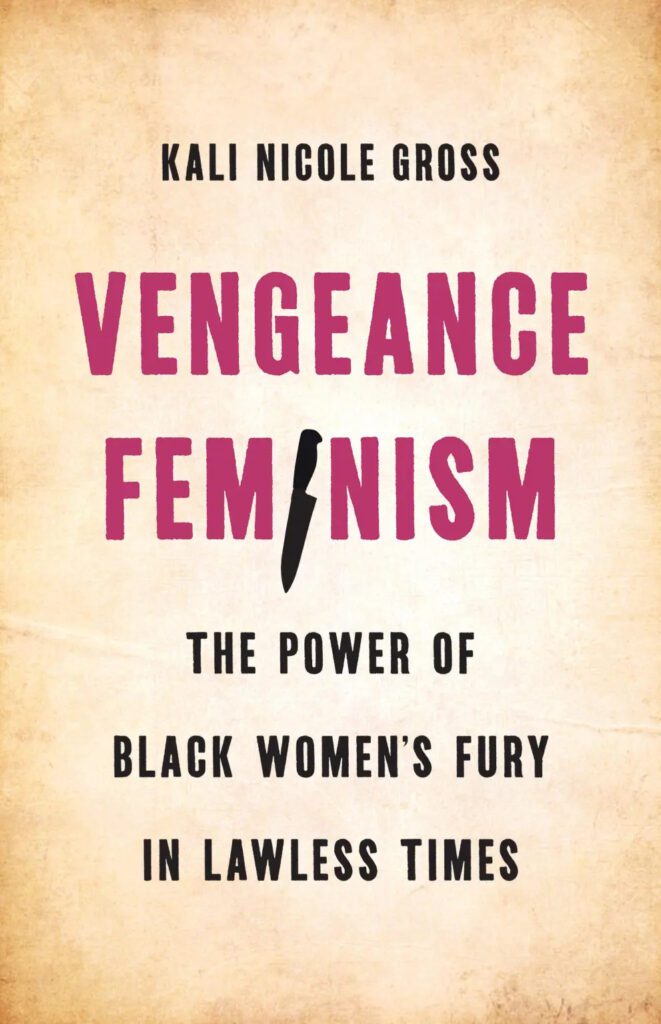
Black Perspectives, the award-winning blog of the African American Intellectual History Society (AAIHS), is hosting a roundtable on Kali Nicole Gross’s award-winning book Vengeance Feminism: The Power of Black Women’s Fury in Lawless Times (Seal Press, 2024). The roundtable is featured in the latest issue (Vol. 2, Issue 1/Spring 2026) of Global Black Thought, the official journal of AAIHS.
Vengeance Feminism is about the Black women who hit back—not always figuratively, and not necessarily nobly either. Weaving together historical narrative with Black feminist analysis, Gross illuminates the stories of Black women who fought for their dignity on their own terms, from the nineteenth-century “badger thieves” who robbed men on the streets of Philadelphia to victims of intimate partner violence who defended their honor and bodily autonomy with deadly force.
The roundtable begins on Monday, May 4, 2026 and concludes on Tuesday, May 12, 2026. It will feature pieces from Antoinette Burton (University of Illinois, Urbana-Champaign), Cheryl D. Hicks (University of Delaware), Sophia Evangeline Gumbs (Brown University), Tracey Johnson (University of Georgia), Jenn M. Jackson (Syracuse University) and DaMaris Hill (Morgan State University). At the conclusion of the roundtable, the author Kali Nicole Gross (Emory University) will respond.
During the week of the online roundtable, Black Perspectives will publish new blog posts every day at 5:30AM EST. Please follow Black Perspectives (@BlkPerspectives) and AAIHS (@AAIHS) on Twitter, like AAIHS on Facebook, or subscribe to our blog for updates. By subscribing to Black Perspectives, each new post will automatically be delivered to your inbox during the week of the roundtable.
About the Author

Kali Nicole Gross is the National Endowment for the Humanities Professor and Chair of African American Studies at Emory University. She is a Distinguished Lecturer for the Organization of American Historians (OAH). An interdisciplinary scholar, her primary research explores Black women’s historical experiences in the U.S. criminal justice system, and her expertise and opinion pieces have been featured in press outlets such as TIME, The Washington Post, The Root, and BBC News. She has appeared on venues such as C-Span, MSNBC, and NPR.
She is the author of three award-winning books, and her latest monograph, Vengeance Feminism: The Power of Black Women’s Fury in Lawless Times, which won the 2026 ASALH Book Prize and the 2026 PEN Open Book Award. Her grants and fellowships include the Carnegie Fellowship, Schomburg Center for Research in Black Culture: Scholar-in-Residence Award, the Ford Foundation Postdoctoral Fellowship, and she was a Public Voices Fellow for The Op-Ed Project. Her newest work examines the historical experiences of Black women and capital punishment in the United States.
About the Participants
 Antoinette Burton is a feminist historian of 19th and 20th century Britain and its empire whose work has tried to bring history from below into the discipline’s broader field of vision. Her academic training and her expertise in anti-imperial history together shape her daily engagements with institutional culture and power. A former head of History at Illinois (2005-2010), she became the Director of HRI (previously IPRH) in 2015, just at the moment that it moved into the Office of the Vice Chancellor for Research and Innovation and into its new premises at the Levis Faculty Center. She has been a recipient of fellowships from the ACLS, the NEH and the John Simon Guggenheim Foundation and she is currently the Maybelle Leland Swanlund Endowed Chair at the University of Illinois, Urbana-Champaign. Burton has written on topics ranging from feminism and colonialism to the relationship of empire to the nation and the world. Women, gender and sexuality have always been central to her research, much of which has been concerned with the role of Indian women in the imperial and postcolonial imagination. She was the editor of the Journal of Women’s History with Jean Allman (2004-2010) and she edits a series of primers for teaching history at Duke University Press.
 Cheryl D. Hicks is an associate professor of Africana Studies and History at the University of Delaware. Her research addresses the intersections of race, class, gender, sexuality, and the law. She specializes in late nineteenth and twentieth-century African American and American history as well as urban, gender, and civil rights history. Hicks is the author of Talk With You Like a Woman: African American Women, Justice, and Reform in New York, 1890-1935 (University of North Carolina Press, 2010), a book that illuminates the voices and viewpoints of black working-class women, especially southern migrants, who were the subjects of urban and penal reform in early-twentieth-century New York. The book won the 2011 Letitia Woods Brown Book Award from the Association of Black Women Historians and honorable mentions from the Organization of American Historians’ Darlene Clark Hine Award and the American Studies Association’s John Hope Franklin Prize. She has published in The Journal of African American History, The University of Pennsylvania Law Review, and the Journal of the History of Sexuality. Her current project focuses on the shifting meanings of sexuality, criminality, and black civil rights struggles in Gilded Age and Progressive-Era America.
 Sophia Evangeline Gumbs is a doctoral student in the Department of Africana Studies and a master’s student in the Department of History at Brown University. She is a Black feminist scholar working at the intersections of Black studies, women’s and gender studies, the history of medicine, and 19th-century African American women’s history, with historical and contemporary research interests including traditional midwifery, early Black feminist thought, the history of medicine, care economies, and reproductive and birth justice. Sophia is also a certified perinatal doula, childbirth educator, lactation counselor-in-training, member of SISTA Fire RI, and co-coordinator for the Doulas of Color Network, a peer-to-peer support and mentorship space for birth workers and aspiring birth workers of color in Rhode Island. She grew up in Cleveland, Ohio and has lived, worked, and studied in Providence, Rhode Island since 2022.

Tracey Johnson is Assistant Professor of History and African American Studies at the University of Georgia. Her research focuses on Black artist-educators in twentieth century New York City. She teaches courses on African American Women’s History, African American Museum Studies and Art History, and well as twentieth century social movements. She has published review essays and articles for Black Perspectives, Historical Studies in Education, and The Journal of African American History. She is now writing a book tentatively entitled Black Arts Democracy: How Black Arts Education Advanced Black New York, 1929-1993, scheduled to be published by the University of North Carolina Press.
 Jenn M. Jackson is an Assistant Professor at Syracuse University in the Department of Political Science. Jackson’s primary research is in Black Politics with a focus on racial threat and trauma, gender and sexuality, political behavior, policing, and social movements. Jackson holds affiliate positions in African American Studies, Women’s and Gender Studies, and LGBT Studies. Jackson is the author of Black Women Taught Us: An Intimate History of Black Feminism (Penguin Random House, 2024). The book is an intimate intellectual and political history of Black women’s activism, movement organizing, and philosophical work that explores how women from Harriet Jacobs to Audre Lorde to the members of the Combahee River Collective, among others, have for centuries taught us how to fight for justice and radically reimagine a more just world for us all.
 DaMaris B. Hill is a poet, creative scholar, and Chair and Professor of Creative Writing and English Literature at Morgan State University. Her most recent book, Breath Better Spent: Living Black Girlhood, is deemed “urgent” and “luminous” in a starred Publisher’s Weekly review. Hill’s A Bound Woman Is a Dangerous Thing, is a powerful narrative-in-verse that bears witness to Black women burdened by incarceration. Her next book, a memoir entitled Blood Bible: An American History, will be published with Bloomsbury in 2027. Similar to her creative process, Hill’s scholarly research is interdisciplinary. She was named a National Endowment for the Humanities Fellow at the John Carter Brown Library at Brown University and a fellow with the Hutchins Center for African and African American Research at Harvard University.