
Power, Slavery, and Capital: An Interview with Jennifer L. Morgan
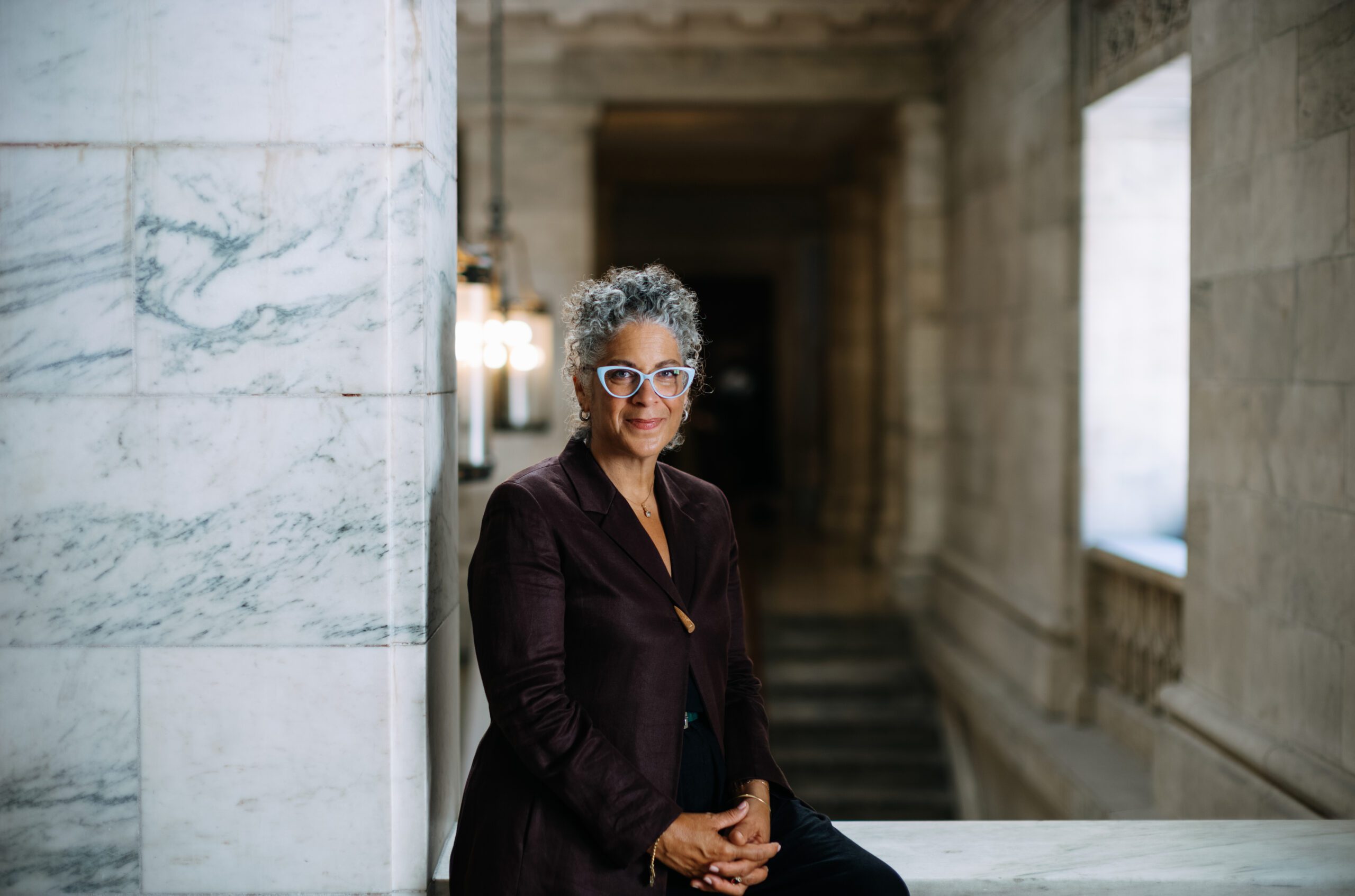
In today’s post, editors of Global Black Thought, interview Dr. Jennifer L. Morgan about her research and writing. Dr. Morgan, a 2025 McArthur Fellow, is Professor of History in the department of Social and Cultural Analysis at New York University. She is the author of Reckoning with Slavery: Gender, Kinship and Capitalism in the Early Black Atlantic (Duke University Press, 2021), which won the Mary Nickliss Prize in Women’s and/or Gender History from the Organization of American Historians and the Frederick Douglass Prize awarded by the Gilder Lehrman Center for the Study of Slavery, Resistance, and Abolition; and Laboring Women: Gender and Reproduction in the Making of New World Slavery (University of Pennsylvania Press, 2004). She is the co-editor of Connexions: Histories of Race and Sex in America (University of Illinois Press, 2016). Her research examines the intersections of gender and race in in the early modern Black Atlantic.
Global Black Thought (GBT): How has the study of race in colonial Latin America and the Caribbean evolved since you first entered the field?
Jennifer L. Morgan (JLM): I started graduate school in 1988. And when I first entered the field, I was an Americanist who wanted to work on race in the 20th century. When I arrived at Duke University, D. Barry Gaspar was there, Peter Wood was there, and Julius Scott was there. So, I got pulled back in time and then also into what we now call the Black Atlantic, which at that point was still super new. The history of slavery was its own kind of discrete academic and historiographical space. And it was primarily studied by folks working on North America but through the scholarship of Gaspar and Scott, the Caribbean was brought to the attention of students like myself at Duke. My perception was that Latin Americanists did not work on race or slavery. Those people who had questions about slavery were usually relegated, I think, to a kind of side space. In the spirit of full confession, a lot of what I know about that early work in Latin America comes from my husband, Herman L. Bennett, who was in graduate school at Duke at the same time as I was. When he talked about writing about the history of slavery in colonial Mexico, people were like, “What are you talking about?”
The history of slavery in the Caribbean was dominated by plantation-based studies like those of B. W. Higman or Michael Craton. [Within the study of plantations,] scholars were interested in the question of resistance or questions of cultural formation, writing in the wake of Herskovitz and others. And there were people who were interested in the Caribbean as part of an imperial theater—the ways in which the Caribbean is part of the history of England and of France and of Spain, but not on its own terms. At the time, I was aware of what felt like a” fight” over how to integrate the study of the Caribbean as a region with the study of race, slavery, and its afterlives, with the study of Latin America, and then with what became the Atlantic world.
GBT: What drew you to your respective fields of Barbados and Black women?
JLM: There are two texts that are most important and also two people. I arrived at Duke University when Julius Scott was hired as a faculty member. Now, he had gotten his degree at Duke two years before in 1986. But he comes in as an assistant professor, and he’s teaching a course on slavery in the Atlantic world. I don’t know if it was called that at the time. But Scott’s dissertation—and many of us who worked with him have spoken on this—everybody read it. Vincent Brown says we circulated it like an “underground mixtape.” It was a thing that you passed from person to person because, of course during the 1980s, it was Xeroxed and Xeroxes were expensive. So, you read it and then lent it to somebody else.
In my first semester of graduate school, I was taking the methodology course. One of the requirements was to read a recently defended dissertation that came out of the history department. I chose Scott’s dissertation because it was about slavery, and I was interested in slavery. And it’s like the most magical and insanely phenomenal dissertation ever. The work centers the network of communication laid by enslaved and free Black sailors and those working in and around port cities in the era of the Haitian Revolution, but what is so compelling and enduring about his work is that it is organized around his insistence that historians must center Black life. Nationally defined histories don’t make sense if you center Black life, especially in the period of the slave trade. [His dissertation] redefines the way that we understand a region or a space. There’s an impact, a direct connection between Black life and new ways of understanding geography. I will say that I continue to assign Scott’s dissertation [published by Verso in 2018 as The Common Wind: Afro-American Currents in the age of the Haitian Revolution]. I think a lot of current graduate students who encounter it don’t understand that it is almost unchanged from 1986. At times, his argument seems obvious to them. But it was not obvious—he was the first person to say this stuff. And I mean, it’s 1986. It’s seven years before Paul Gilroy published The Black Atlantic, so it was before the phrase Black Atlantic is even in our brains. I just think The Common Wind is the most extraordinary piece of scholarship. It continues to amaze me.
Another scholar and text that influenced me was Peter Wood. I took a course with Wood and read his book, Black Majority: Negroes in Colonial South Carolina from 1670 through the Stono Rebellion, which was published in 1974. He has this first chapter that’s called “The Colony of a Colony,” and it’s about the relationship between Barbados and South Carolina. If you’re doing the history of South Carolina, you can’t do that without discussing the history of Barbados. And that felt super interesting to me. And then finally, Hilary Beckles’s Natural Rebels: A Social History of Enslaved Women in Barbados (1989). I read that as an exercise of understanding a little bit more about slavery in Barbados, and what I suddenly see through his work is a significant gendered critique with Beckles arguing that we haven’t understood the demography of this place and what that means for our understanding of slavery.
GBT: What is the most influential text about race during the colonial period that shaped your work? How did/do you engage it?
JLM: There’s been a wonderful synergistic set of studies that center gender, reproduction, and questions of women’s lives in the context of enslavement that are having a collective conversation. Aisha Finch, Marisa Fuentes, Jessica Johnson, Diana Paton, Jenny Shaw, Shauna Sweeney, Sasha Turner, Tamara Walker and so many others. We are putting forward new sets of questions. I’m working right now on a study of gender and slavery in North America. It’s a 17th century history of North America, and it’s concerned with the way in which ideas of slave ownership and of captivity are moving from the Caribbean and Latin America into Virginia, Maryland, New York, and Massachusetts. These are not self-contained colonies by any means, and this movement of ideas is something that we really have to be attentive to.
GBT: What are some of the current trends in scholarship on race and colonial Latin America and the Caribbean that you notice happening right now?
JLM: The biggest one has to do with asking questions about the history of capitalism and the colonial origins of the connection between capitalism and slavery. I think the resurgence of interest in and engagement with Cedric Robinson’s work is a prime example. Historians are examining how ideas of value and generational wealth, property, and capital all get set in motion during the colonial period by racial capitalism. I also think that questions of reproduction, or more broadly a history of the body in slavery, is another trend. People who are interested in reproduction also study disease, health, and ideas of healing. Here, I am thinking about Pablo Gómez’s work, and I’m thinking about my former student Elise Mitchell. And of course, these are questions that are completely connected to the contemporary moment, from the pandemic to the crisis of late capitalism that we’re living through. It’s not a surprise that the field is responding by asking complicated questions about the origin of these problems.
GBT: Where do you think the field of race and colonial Latin American history is headed? And where do you see yourself in that conversation?
JLM: The history—or a critique—of the archive is obviously important to scholars of slavery and gender. There have been enormously productive conversations about the archive as a site of power and as a site of organizing the ideology around slavery and capital. Some scholars have said the archive can give us nothing because it’s all about preserving white supremacy. I understand that critique, but it is not mine. I feel like what historians have always done for good or ill is to understand the limits of what the archive can yield and then do the work to expand and push against those boundaries. A re-engagement with what the sources say [is the solution]. There’s a student of Sasha Turner’s at Johns Hopkins named Jessica Newby who is working on the Thistlewood Diaries. Some would argue that we already know what’s in the Thistlewood Diaries. But the amount of time and care she is taking to really work through these diaries is enabling her to do some extraordinary work on the lives of the women who are enslaved, the ideologies of slave ownership, and the ideologies of race in the body. And it’s because she has the patience and the commitment to reenter that archive. I also see myself in this conversation about re-engaging with the archive. The book that I’m writing right now is 100% dwelling in colonial North American archives. Some may say there’s nothing new there, right? But I’m new!
This book is organized around the life of Elizabeth Key, who is an enslaved woman in Virginia. But it’s not a biography of her. It uses the arc of her life to talk about other women—and some men—who in 17th century North America are trying to use either the courts or the church or other institutions to protect [their] children. The idea for the book is to ask if these spaces are where we can see the hardening of racial ideology. And the answer is yes. I hope it will start a conversation about what it means to bring a new set of perspectives into an archive that has historically not been seen as having much to do with Black life.
Related to that, I think that there are still important questions, particularly for Latin Americanists, to ask about demography, such as “How many?” and “Who is enslaved?” In Spanish- and Portuguese-speaking countries, how does the data on the transatlantic slave trade [now easily accessible through SlaveVoyages.org] both help and hinder us in terms of understanding the impact of slavery in areas that subsequently get less associated with the slave trade? In the context of North America, there’s work being done on the impact of slavery in in Massachusetts, Rhode Island, Connecticut, and New York. These works are yielding clarity about the economic dependence that Northern industry has on not only the goods that are harvested and manufactured by enslaved people, but also on the task of feeding and clothing those laborers. There are similar questions being asked in the context of Latin America, especially in regions that are currently not as associated with a longstanding history of slavery. So, I think those are two areas that are going to be increasingly important.
*This interview was originally published in Volume 1, Issue 2 of Global Black Thought, a special issue on colonial Latin America and the Caribbean (ed. Erika Edwards). Copyright © 2025 AAIHS.
Copyright © AAIHS. May not be reprinted without permission.